Sunday, July 17, 2005

Sylvia Plath


I was reading some of the reviews of the Sylvia Plath biopic and found a few very interesting observations by some reviewers. Stephanie Zacharek (one of my favourite critics, even though she loathes Lars von Trier) in her review calls Plath's poetry "carping" and bemoans her "extreme self-pity":

Sylvia Plath is a fascinating character but a lousy icon. I don't happen to care much for her poetry: Where others see passion, I see carping; her version of hard-bitten introspection reads like extreme self-pity to me. Would I feel differently if Plath's short and tragic life -- and Hughes' life along with it -- hadn't been hijacked by any number of book-benumbed thinking-cap types who drive agendas as if they were glamorous, racy little red sports cars? Probably. But I can't change the way Plath's legacy has been appropriated any more than I can change the specifics of her life.

It's interesting to speculate of what would have happened had her mental illness not conquered her. How would she have felt about her own poems after some years? After all, she was only thirty when she took her life.

Anthony Lane in his review in The New Yorker is even more unsympathetic towards Plath's poetry. But then he explains his indifference, or rather a "constitutional aversion to her poetry":
Will “Sylvia” send viewers out of the movie theatre and back to the verse, or will they find better and saner things to do? For those slouching toward middle age, Plath’s poems are no longer guaranteed to provide either solace or provocation; she herself, like a war poet, was granted no middle age, and we can never know how the riper Plath might have chosen to outgrow, or even disown, the bitter fruits of her youth. Hers is a country for young men and, more obsessively, for young women; I now suffer from a constitutional aversion to her poetry, as one should to any art or writing that casts a spell on one’s teen-age years, and the extremity of her self-absorption, which a movie as careful and sociable as “Sylvia” can never properly catch, seems as likely to repel as to entrance.

And don't miss the review in Slate for its delightful opening line:
Complaining that a biopic of Sylvia Plath is oppressively bleak is like complaining that a steam room is oppressively moist. Bleakness, it may be argued, is the whole damn point, and it obviously did oppress Plath, who in her last months was probably happiest when fantasizing about her own suicide.

He then coins a new term for the genre, he calls it "the Bleak Chic"! And the review in The Village Voice has this delightful phrase about the Hughes-Plath industry:"Deconstructing the rugged übermensch and the maenad housewife spawned its own literary subgenre (or Plathology?)."

These pronouncements do sound a little insensitive at first but then if you remove the sad and bleak prism of the Sylvia Plath's actual life through which we inevitably end up looking at her poetry, perhaps these critics do make some sense. And while we are at it, I mean berating the adolescent tendencies of self-pity and carping, I can't help but link to the wonderful short essay by Jonathan Yardley of Washington Post, in which he delivers some (rather well-deserved I would say) spanking to the patron saint of adolescent angst, self-pity and "jejune narcissism", Holden Caulfield:
[...]"The Catcher in the Rye" can be fobbed off on kids as a book about themselves. It is required reading as therapy, a way to encourage young people to bathe in the warm, soothing waters of resentment (all grown-ups are phonies) and self-pity without having to think a lucid thought. Like that other (albeit marginally better) novel about lachrymose preppies, John Knowles's "A Separate Peace" (1960), "The Catcher in the Rye" touches adolescents' emotional buttons without putting their minds to work. It's easy for them, which makes it easy for teacher.

Emotional button pushing? Hmmm. I wonder what Yardley thinks of Harry Potter and the fascination it inspires in adults.

Saturday, July 16, 2005

Ted Hughes

Ted Hughes was one of the greatest of post-war English poets. Although more than his poems, he is famous for being the husband of Sylvia Plath, whose suicide in 1963 turned her into the most potent literary icon of twentieth century, not to say the patron saint of feminism (of the angsty victimhood variety). It also turned Hughes into a callous, brutal and insensitive husband who jailed and tortured his genius wife while sleeping with other women. The publication of Ted Hughes's Birthday Letters in the late nineties, a collection of poems about the their life together, undid most of the damage to his reputation. It soon became the fastest selling book of poetry ever published, but then it hardly had anything to do with poetry. It just showed how entrenched the Plath myth had become in our popular culture.

I am currently reading a biography of Ted Hughes, called simply Ted Hughes: The Life of Poet by Elaine Feinstein. It claims to be an "unbiased" biography written from the point of view of Ted Hughes's literary achievements rather than just his relationship with Plath. Should be an interesting read. I knew that his second wife Assia for whom he left Sylvia also committed suicide but I didn't know that before taking her life she killed their daughter too. I was surprised that I did not know this before. Taking your own life is one thing (an honourable thing I say, but more on that later) but killing your two-year old daughter by giving her sleeping pills with whisky is just too much. I hope the biography has some details about what really happened.

I have been reading some stuff from the internet and refreshing myself with the details of the Hughes-Plath story. I came across some very interesting articles. Specially worth reading are the articles from Salon. Look up the directory for Sylvia Plath and Ted Hughes related articles here and here. Specially worth reading are articles on the Plath journals by novelist Kate Moses, who wrote a fictionalized account of the traumatic period of Plath's life before she took her life and composed her masterpiece Ariel. The two parts of the article are here and here. She also speculates that it was perhaps PMS and complex biochemistry which drove or at least contributed to her suicide (must he hard being a woman!). The journal of the period when she wrote the Ariel poems were destroyed by Ted Hughes soon after her death. Ted Hughes also edited and reorganized her poems in Ariel, which some critics claim, he did heavy-handedly, turning the theme of tranformative re-birth into a tale of inevitable self-destruction. He later defended his actions by saying that he wanted to protect his children from all that "sadness". Also worth reading is the moving review of Birthday Letters by Jay Parini (you can find it here). And if you want a different perspective (a feminist one) you can read Katha Pollitt's (one of my favourite woman columnists) review in The New York Times (here).Also the Guardian profiles of Ted Hughes and Sylvia Plath. Scroll down to the bottom of the page to get to the articles or do a search on the site! Another article from Slate about the biopic which came a few years back on the life of Plath in which Gwyneth Paltrow played the title role. Another article has a very good summary of the whole literary controversy for the beginners. So if you don't know anything about the affair start with that one.

Thursday, July 14, 2005

David Cronenberg and Nabokov

David Cronenberg in an interview, rather interestingly titled as The Baron of Blood Does Bergman, says that his favourite writer is Nabokov. When asked if the idea of the fragility of memories and self-knowledge that he explored in his film Spider has anything to do with Nabokov, he replies:

In his case very specifically, yeah. A past that he was severed from before he wanted to be. He's one of my favorite writers. He was an important figure for me. One of the reasons I'm not a novelist, probably, is because I kept writing pastiches of Nabokov. Whereas when I came to filmmaking I felt quite free.


I personally found Cronenberg's Spider to be extremely pessimistic about the nature of memory and the possibility of self-knowledge and coming-to-terms with one's past, and so poles apart from Nabokov's Speak, Memory which is a homage full of love on the altar of Mnemosyne (the goddess of memory). Can we recreate through artistic imagination what has been irretrivably lost? Nabokov and Proust surely think we can. Cronenberg is not so optimistic. He thinks that even if we are able to recreate our pasts it will be nothing but the sum of our delusions. Self is an illusion, only fear, anxiety and sexual pathologies are real (a very David Lynchian concept!).

Pale Fire, A Supernatural Novel?


On The Guardian Books website Jeremy Sheldon (don't know who he is!) picks up his top 10 fiction books about ghosts and spirits. It is a very interesting list, all the more interesting because it comes amidst all the brouhaha about the latest Harry Potter book. Surely, future generations will see our collective and infantile fixation with the wizard as we see the crazy mania for tulip bulbs that gripped the Dutch people in the seventeenth century. If someone writes a new edition of "Extraordinary Popular Delusions and the Madness of Crowds", Harry Potter mania along with Da Vinci Code tomfoolery will surely find a place there.

Anyway, what I found interesting about the list, other than the exclusion of the usual suspects, was the inclusion of Vladimir Nabokov's Pale Fire in it. Pale Fire, at least on the surface, is not a supernatural story at all. At the center of the novel is the eponymous poem, which is identified in the foreword as the last work of the late American poet John Shade. The rest of the novel is in the form a commentary by someone called Charles Kinbote, who also wrote the foreword to the poem. What makes the commentary a delight to read is the peculiar voice of the commentator. Kinbote is the ultimate unreliable narrator - in fact, an unreliable narrator to end all unreliable narrators. Kinbote weaves into his footnoted annotations on the poem the story of his own relationship with the poet, John Shade. How he befriended him during the last months of his life while Shade was composing "Pale Fire." How he'd disclosed to Shade, a colleague at the college where they both taught literature, the fantastic story of his (Kinbote's) supposed secret identity: that he was not really Charles Kinbote, but rather the exiled King of Zembla, "the distant northern land" (yes, that's where the title of this blog comes from) where he once ruled as Charles the Beloved until he was deposed by evil revolutionaries from whom he fled into exile. Revolutionaries who sent an assassin to hunt him down, an assassin whose bullet, meant for Kinbote, mistakenly killed John Shade instead. And now, having absconded with the dead poet's manuscript of "Pale Fire," holed up in a cave in the mountains, Kinbote attempts to demonstrate with his commentary that Shade's last masterpiece is really about him, about Kinbote, about his own tragic and romantic life as King of Zembla, his flight and exile. All this despite the fact that, on the surface, neither Kinbote nor Zembla appear anywhere in Pale Fire, despite the fact that the poem seems on the surface to be John Shade's attempt to come to terms with his own tragedy, the suicide of his beloved daughter Hazel Shade-and his efforts to explore the possibility of contacting her in the Afterlife, across the border between life and death ("the foul inadmissible abyss") which has exiled her from him.

One of the most interesting and longest running mysteries of modern literature is the authorship question of the book. Who is the real "author" of Pale Fire? Mary McCarthy, the well known literary critic and wife of Edmund Wilson, Nabokov's estranged friend, conjectured in a review published at the time when the novel itself was published that the real author of both the poem and the commentary is V. Botkin, "an american scholar of Russian descent", who is mentioned only in the index. I haven't read the review (it's called "A Bolt from the Blue") so don't know much about how she reached that conclusion but this theory was later revised by Brian Boyd and other critics who called themselves "Shadeans" because they thought it was John Shade who wrote the poem and then invented a delusional literary critic to do an exegesis on his own work. There is also a group called "Kinboteans", although in minority, who think it is Charles Kinbote who invented the poet John Shade and not the vice versa. And then there are literalists, like me, who see the book as a satire on the lit-crit industry, a heart-felt meditation on what it means to live with a constant knowledge of death, of one's own and of everybody we love and of course that "undiscovered country from where no traveler returns" or "the foul, inadmissible abyss" as Nabokov calls it.

The "Shadean" theory held sway among majority of the Nabokov scholars for long, and it still does, but Brian Boyd (once again) muddied the waters a few years back by arguing, in a book length critical study, that the real source, the true inspiration for the land of Zembla and the poem, is not Kinbote or Shade or Shade-from-beyond-the-grave, but John Shade's dead daughter Hazel whose ghost indirectly insinuates Zemblan promptings into both John Shade's poem and Kinbote's beautifully mad commentary to it (making Zembla that elusive unknowable place of after-life). I haven't yet read the book, so I don't know much about it. But it seems Jeremy Sheldon (who put the book in his favourite supernatural books) has surely read Boyd's book. Supernatural or otherwise, Pale Fire is definitely a book which deserves to be read again and again to fathom its endlessly intricate mysteries. More posts about the book will follow. After all this is a dispatch from Zembla!

Tuesday, July 12, 2005

Home is so Sad

By Philip Larkin

Home is so sad. It stays as it was left,
Shaped to the comfort of the last to go
As if to win them back. Instead, bereft
Of anyone to please, it withers so,
Having no heart to put aside the theft

And turn again to what it started as,
A joyous shot at how things ought to be,
Long fallen wide. You can see how it was:
Look at the pictures and the cutlery.
The music in the piano stool. That vase.


I will be back home very soon and no, my home isn't sad at all!

Sunday, July 10, 2005

Happy Birthday


Happy Birthday to M. Proust !

Saturday, July 09, 2005

Three Cheers for Dopamine, Norepinephrine and Serotonin

Whenever I tell people that I am an atheist, reductionist and materialist and that I do not believe in after-life, soul or disembodied existence, the first reaction is always a strange look and after a while, perhaps since they know that arguing about the existence of God in an objective manner is fruitless, they ask, but Alok, do you believe in love? Have you ever been in love? As if, my not believing in soul has automatically turned me into a robot or a stone statue! Long lives the cliches of science fiction! Anyway, my answer to the first question is always the same: I believe in everything which has evidence and which can be verified and falsified by the scientific method of induction and as for love, there is enough evidence. As for the second question, if personal and first-hand experiences were required for knowing everything, Shakespeare would have been a murderer, misogynist, anti-semite, maniac, depressive, delusional, fool, knave and lots of other things which obviously he was not! So that is obviously absurd.

Now coming to the post that I wanted to write. I do believe in love as I believe in every other emotion, like anger, fear or disgust. The only thing I do not believe in, is that there is some mystical side to it, which can not be understood in an objective manner and that, it disproves or weakens the materialist philosophical position. Like all emotions, love is firmly embodied in our central nervous system and its chemical secretions. Love only appears different because it is far more intense and far more complex than other emotions (one reason might be that it always involves more than one person).

It is now a well accepted theory that like every other emotion, love is an evolutionary adaptation. It has been a successful adaptation because it enabled our ancestors to focus their courtship attentions on a single individual at a time, thereby conserving precious mating time and energy which as a result made it a winning strategy (as compared to the "f#$% and leave" strategy) as far as the struggle to pass on the genes to the next generation goes. But, then you will ask, why so much emotional upheaval that goes with love? How can something be a successful adaptation if it makes people suicidal and throws them in deep despair? Well the answer is because of the three chemical secretions that I wanted to write about.

Elevated levels of dopamine (and norepinephrine which is its derivative) in the brain produce extremely focused attention, as well as unwavering motivation and goal-directed behaviors. And there goes the explanation of compulsive mails, phone-calls and stalking, that is invariably found in every love affair. It also keeps lovers intensely focused on the beloved, often to the exclusion of all around them. Indeed, they concentrate so relentlessly on the positive qualities of the adored one that they easily overlook his or her negative traits (great men have wrote about it, look here and here). It has also some role to play in making lovers believe that the object of their desire is unique and unlike any other. Ever tried convincing a rejected lover that he/she can find someone exactly like her/him?

Dopamine is also responsible for other feelings that lovers report - including increased energy, hyperactivity, sleeplessness, loss of appetite, trembling, a pounding/beating heart, accelerated breathing and sometimes mania, anxiety or fear. This also explains why people in love become so dependent on their loved ones. Scientists have even found out that the feelings of dependency and craving that people feel in love are the same as those found in people addicted to alcohol or something else. So then, is love an addiction? Yes; most definitely it is--a blissful dependency and addiction when one's love is returned; a painful, sorrowful, and often destructive craving when one's love is spurned or when it remains unrequited.

In case of serotonin however, it is the low levels of the chemical which create troubles like obsessive-compulsive behavior and lover's persistent, involuntary, irresistible ruminations about their loved ones. In fact Prozac, the famous medicine used to treat Obsessive-Compulsive Disorders, actually belongs to the class of medicines called SSRIs (Selective Serotonin Reuptake Inhibitors) used to elevate levels of serotonin in the brain.

Now onto the most important question: How do I know all this stuff? And how do I know what people in love go through? Let me clarify. All this is based on purely objective reading of books, articles and other people's experiences. And anyway it is very un-Proustian and un-Nabokovian (two of my literary gurus) to use author's biography to understand what author has written. Two books that I will heartily recommend are Why We Love: The Nature and Chemistry of Romantic Love by Helen Fisher and The Evolution of Desire:The Strategies of Human Mating by David Buss. In fact I have blatantly plagiarised most of the stuff that I wrote above from the first book! If you have recently fallen in love and are enjoying the highs don't go near Buss's book. It will create unnecessary confusions. And if you think that understanding love and other mysteries of nature in a scientific manner destroys or even diminishes the pure and primitive magic of feeling, read Unweaving the Rainbow by Richard Dawkins.

Thursday, July 07, 2005

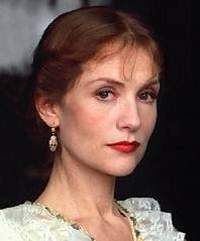
Three Cheers for Isabelle Huppert


Isabelle Huppert is one of the best actresses (okay, actors if you insist) working in cinema today and certainly my favourite. She is famous for playing some of the most scandalous and transgressive roles in recent cinema. She has played among other roles, "sluts, nutters, illiterate murderesses, abortionists, psychopathic matrons, brothel madams, petit-bourgeois housewives purring with resentment and unslaked sexual thirsts." In her latest film Ma Mere, she shares some queasily erotic scenes with her on-screen son. The New York Times says:

The great French actress Isabelle Huppert, whose fondness for the transgressive has led her to star in movies like "The Piano Teacher" and "The School of Flesh," has finally shot the moon with this one.


I have seen only three of her films so far. In Claude Chabrol's Story of Women she plays an abortionist with such clinical and cold-hearted brilliance that it made even a radical pro-choicer like me flinch for a while. And her acting in The Piano Teacher left me profoundly disturbed. I was depressed and had lurid nightmares about blood and blades (if you don't know, don't ask) for two full weeks after watching that film. Her role in the recent I Heart Huckabees came as a welcome relief. What can be better than seeing Isabelle Huppert peddling the theory of "cruelty, manipulation and meaninglessness" and offering void and nihilistic disconnectedness as an antidote to the cloying Buddhist philosophy of Dustin Hoffman! Everything matters and everything is connected? Not for her. And so not for me!

Here is a delightful short profile of her. She is supposed to have said sometime: "Acting is a way of living out one's insanity." Check out her films to know what she meant when she said that.

Wednesday, July 06, 2005

Kierkegaardian Motifs in Lars von Trier's Breaking the Waves

Okay, this is the not the post I wanted to write. But I don't have any time and I don't understand Kierkegaard at all.

I have tried reading A Very Short Introduction to Kierkegaard (actually I read it last year and now I don't remember a thing), and I spent most of my Monday (which was a holiday) trying hard to understand what Kierkegaard wanted to say in Either/Or, Sickness unto Death, Concepts of Dread, Fear and Trembling and Works of Love. But, no success. I am still trying to understand the difficult interconnectedness between faith, passion, subjectivity and love. Once I get hold of something, I will write about how it all illuminates Breaking the Waves, one of the greatest fairy tales ever told.

Some interesting stuff that I read about Kierkegaard:
Roger Kimball wonders What Did Kierkegaard Want? Well, isn't that the whole point of existentialism? Here is one by John Updike, from that august literary institution The New Yorker. And Peter Kramer, psychiatrist and the author of Listening to Prozac, wonders what would have happened if Kierkegaard took anti-depressants. More stuff here and here.

And if you are wondering what the fuss is all about and who the hell is Lars von Trier or if Breaking the Waves is a fairy tale why haven't I come across it in my volume of brothers Grimm...you can educate yourself by visiting here and here.

Saturday, July 02, 2005

My Blog is Boring

Not that I didn't know this before, but I was reminded of this again early morning today (waking up at 5 on a Saturday morning? something is seriously wrong somewhere). I was browsing the blogosphere and came across two very interesting blogs, both of the baring-the-soul genre. I generally don't spend much time reading these stupid confessions of stupid twenty-somethings about what they did in some stupid party with their stupid friends. But these blogs were different, specially the first one which is called The scab that swung. I don't know about "swinging" but the blog definitely scores high on how-tos of scratching scabs. This girl who calls herself TeeGee (is that her initials? Tara, Tanya, Trisha or may be Tamara, who knows she might even be from Russia or be a Nabokov fan!) is having some serious boyfriend issues. I spent quite some time trawling through her blog archives in the wee hours of today morning, and using some hints that she had left here and there even did some cyber stalking (by which I mean innocent googling). The guy in question is some kind of an upstart in the Indian news television scene and has just launched a new channel in the eastern part of India. And if his real name has anything to do with the initial that the girl uses to address him, I think I know who he is. I hope she never reads this and if she ever does, doesn't sue me for stalking her blog!

Most of her posts, not surprisingly, are about trying to forget and not being able to, scratching the scabs which appear to have healed but apparently have not, uncertainties and mood swings that go with every serious love affair. Sometimes I think how predictable these things are. Be it the innocent shepherds and their melancholy love stories in Don Quixote or the obsessive quest to reach the bottom-most depths of human heart in Proust's Novel, they all are absolutely the same, at least in abstract terms. Not that I am comparing her to Proust or Cervantes, but honesty and courage for self-revelation even under an assumed name go quite far.

The second blog is equally interesting. It's called liquid sunshine and it is about heart break too, straddling some open space between Bridget Jones and Sylvia Plath. Don't miss her open letter to her mom. And I always thought mothers and daughters were best friends!

And yes my blog is boring, unlike these blogs, because there is hardly any me anywhere here, hardly any passion, any genuine feeling, just borrowed thoughts and ideas and used feelings. I can imagine how romantic and poetic it would be to scratch the scabs, but what if you don't have any scabs to begin with?

Be that what it is, I don't have any plans to popularise my blog by making it a confessional barf bag. It looks good as it is. Monday is a holiday so I should be able to read something substantial over the weekend and then I can write about it. I am already thinking of some more boring posts, such as, Kierkegaardian Motifs in Lars von Trier's Breaking the Waves or Menippean Strain in Dostoevsky as Discussed by Bakhtin or perhaps moving on to history and politics I can write about the comparative analysis of the views of Marx and Feuerbach on the Jewish Question or a comparative analysis of the anarchist philosophy of Proudhon, Herzen and Bakunin...phew! there is so much to write about. Why waste time searching for old scabs?

Friday, July 01, 2005

More Tidbits on David Lynch

David Foster Wallace, the well known American novelist, tries to define the word "Lynchian":

"Some guy killing his wife in and of itself doesn't have much of a Lynchian tang to it, though if it turns out the guy killed his wife over something like ... an obdurate refusal to buy the particular brand of peanut butter the guy was devoted to, the homicide could be described as having Lynchian elements."


And a judgment of Blue Velvet from a film critic, when the film was released (it would have immediately made me run to the nearest movie theatre playing the film, had I read it at the time when the film was released!):
"In the brain-damaged garbage department, Blue Velvet gives pretentiousness new meaning. It should score high with the kind of sickos who like to smell dirty socks and pull the wings off butterflies, but there's nothing here for sane audiences.... Bring a barf bag."
-- Rex Reed, New York Post (September 19, 1986)


One clarification, I don't like to smell dirty socks and I abhor torturing delicate creatures like butterflies (my admiration for Nabokov notwithstanding).

More critical reactions, but none as hilarious, can be found here.

David Lynch's Blue Velvet

David Lynch is without doubt the greatest film maker working in cinema today, closely followed by David Cronenberg and Lars von Trier. Okay, in case you start accusing me of western bias or worse, ignorance--Martin Scorsese (by the way, should we call him contemporary?), Abbas Kiarostami, Wong Kar-Wai and others in China, Japan and Korea are good too. But having said that, hardly anyone's work comes even close to what Lynch has achieved in his rather short career, specially given that he is working in the mainstream Hollywood system. There is hardly any contemporary filmmaker who can claim to have an adjective derived from his name. The word "Lynchian", in its signification of the convergence of bizarre depravity with the surface normalcy of the mundane, conveys meanings which can only be experienced and felt.

I was confirmed in my beliefs after watching Blue Velvet the other night after a gap of almost two years. I was quite surprised to find out how the film has lost none of its powers to shock and unnerve me. And this was when, this time, I was consciously and objectively trying to understand the technique of the film and knew very well that the film was symbolic, not to be taken literally (it might just be a defence mechanism). I knew that the film was an allegory about the pains of growing up, a rather Miltonic screed on the pitfalls of gaining knowledge and the shock that comes with the loss of childhood innocence when initiated into the dark and twisted world of adult sexuality. But even with knowing all this, the film does manage to affect at a visceral level, and that's what makes Lynch's style so unique and so one-of-a-kind.

The first reaction to the film generally is--ohh, I know Lynch is just a smart guy, but things are not as dark or depraved as he thinks they are--but then Lynch is hardly making a general statement about human nature or indulging in social criticism, although it is equally valid to read the film in both ways--as psycho-analysis of sexual pathologies and social satire on the phony normalcy of suburban American life. What this film actually does is that it forces even the most passive and lazy viewer to take the same journey of self-discovery, that the hero takes, into the deeper recesses of self and confronting the darkness that lies inside, buried under the fragile sanity of everyday routine life. Of course not everybody likes this idea but for those willing to stare down the darkness, Lynch's films are, "like our own nightmares, oddly informative". Whether onscreen or in the world outside, we can't defeat our demons without knowing who they are and that's what makes David Lynch not only the best but also the most important filmmakers working today.

Samaritan Girl


Kim Ki-Duk is one of the most controversial and polarising film makers working in the world cinema today. He is mainly famous for the violent and sordid psycho-sexual melodramas that he made early in his career, specially The Isle and Bad Guy. After making his rather nasty reputation with those films he surprised critics and fans with a very restrained and elegiac Buddhist fable Spring, Summer, Autumn, Winter...and Spring and then following it up a melancholy love story 3-Iron. There was violence in these films too but that remained mostly in background and was always shown in an oblique and artistically mature manner. His latest film, Samaritan Girl, which won silver bear at the Berlin film festival last year, continues the same tradition of his last two films.

The film is about two beautiful school girls who resort to prostitution so that they can save money and fulfill their dream of visiting Europe. The film is divided into three parts. The first part, "Vasumitra", starts with one of girls reciting the story of a (mythical?) Indian prostitute of the same name, whose clients turned devout Buddhist after having sex with her. The film then goes on to make a violent mockery of this naive and sentimental belief in the nurturing and spiritual potential of sexuality, as we see one of the girls managing the transactions and the other sleeping with her middle-age clients, to make some fast buck. The events come to tragic conclusion when one of the girls (who was prostituting herself) jumps off from a window and dies following a surprise police raid. In the second part, "Samaria", which seems like a bizarre perversion of the Christian idea of "the good Samaritan", the second girl decides to atone for her sins by sleeping with all the men who slept with her friend (actually, it is suggested that they were more than just friends) and also returning their money back. The situation gets complex when the girl's father, who is still recovering from his wife's (unexplained) death comes to know about the sordid degradation that his daughter is subjecting herself to. He then starts stalking the men and finally murders one of them in a typically brutal manner.

The third part, "Sonata", tries to tie everything together when the father and daughter go on an idyllic vacation and try to confront their own inner demons without telling each other anything. The film ends bafflingly when the father after giving his daughter preliminary driving lessons, leaves her alone and surrenders himself to the police. But only after he has seen his daughter crying silently in the night, and thus making sure of her essential virtuousness. An article in the Senses of Cinema notes that:

It is with this refreshing sense of hope, combined with an astute eye for social detail and aesthetic composition, that Kim creates one of the most profoundly moving and strangely transcendent metaphoric images of intruded-upon (and violated) landscape in recent cinema, in the final shot of Samaritan Girl: the errant sight of a wobbling, out of control car struggling to chase a sports utility vehicle through a flooded gravel road in the rural countryside, doggedly navigating the inhospitable terrain using an innate compass that elusively, but transfixedly, points home.


The film does manage to express its ideas about religious and spiritual yearning, sin and guilt, quite eloquently, but overall the style and the metaphors the film uses to do this are too direct, explicit and literal. Some of the scenes are also quite unconvincing because the characters appear not human beings but artificial carriers of the misanthropic world view of their creator. I don't have any problem with misanthropy but this one looked fake. But all these quibbles notwithstanding, the film did manage to leave me with a faint ache in the heart which stayed with me for quite some time, along with the angelic faces of the two girls. And that was sufficient reward for me for the time spent watching it. However, Jonathan Rosenbaum doesn't agree with this.

Tuesday, June 28, 2005

Anatole France on Proust

Anatole France was one of the major figures in the French literature scene in the late nineteenth and early twentieth century. He even won a Nobel prize for literature in 1921. But he is now mostly known for being the literary mentor of young Proust and more importantly being the real life model of the novelist character Bergotte in Proust's Novel, which Proust uses to expound his own theory of literature and life and how they are related.

I was reminded of this, while reading the introduction that France wrote for Pleasures and Days, the first published work by Proust, which he wrote when he was only twenty two. This is a very short and elegant introduction, which is sadly the best part of the book. The rest of the book is pretty disappointing and will be of interest to only the most hard core Proust cultists (I am going in that direction, but I am still far from there it seems).

France in his introduction starts effusively:

Why did he ask me to present his book to curious minds? And why did I promise to take on this highly agreeable but quite unnecessary task? His book is like a young face full of rare charm and elegant grace. It is self-recommending, tells us about itself and presents itself in spite of itself.

And then in a remarkable understanding of the Proustian theme, which is all the more notable because he could identify it in this early juvenilia , he says:

True, it is a young book. It is as young as its author is young. But it is an old book too, as old as the world. It is the spring of leaves on ancient branches, in the age-old forest. One is tempted to say that the new shoots are saddened by the long past of the woods and are wearing mourning for so many dead springs.
[...]
Even his sadness will be found to be pleasing and full of variety, conducted as it is and sustained by a marvelous spirit of observation, and a supple, penetrating and truly subtle intelligence.


And then in a bravura display of ironical qualifiers:

Marcel Proust delights equally in describing the desolate splendour of the sunset and the agitated vanities of a snobbish soul. He excels in recounting the elegant sorrows and artificial sufferings that are at least equal in cruelty of those which nature showers on us with maternal prodigality. I must confess that I find these invented sufferings, these pains discovered by human genius, these sorrows of art, enormously interesting and valuable, and I am grateful to Marcel Proust for having studied and described a few choice examples.

He lures us into a greenhouse atmosphere and detains us there, amid wild orchids that do not draw the nourishment for their strange and unhealthy beauty from this earth. Suddenly there passes, through the heavy and languid air, a bright and shining arrow, a flash of lightning which, like the ray of the German doctor, can go right through bodies. At a stroke the poet has penetrated secret thoughts and hidden desires.

This is his manner, and his art. He here shows a sureness of touch surprising in such a young archer. He is not at all innocent. But he is so sincere and so authentic that he appears naive, and as such we like him.


It is indeed quite strange and fascinating to see how totally out of place these judgments are for the book for which this introduction was written and yet, at the same time, how accurate it is in the context of his eventual masterpiece. This is literary criticism as divination, nothing else can explain this.

Friday, June 24, 2005

More Books

Brief note on some new books I bought this week, all from the bargain section at the Barnes and Noble. The first book is a mystery novel called Who Killed Palomino Molero? by the great Peruvian novelist Mario Vargas Llosa. I haven't read any genre book in a long while (not that I read a lot), but this looks very interesting. Vargas Llosa is one of my favourites among the contemporary writers. His books not only evoke a great sense of place and culture but also are politically engaged with the complex realities of contemporary Latin America. Politically engaged, that is, without losing sight on the essential human nature on which he always manages to cast a deft eye in all his novels, as all consummate artists do. What is most remarkable in his political views is his scepticism about the utopian and revolutionary solutions to the problems plaguing Latin America. He views them as nothing more than dangerous millenarian delusions. These rather despairing political views are delineated in most of his novels with deftly sketched detail, but in none more successfully than in The War of the End of the World, which is possibly the greatest Latin American novel ever along with Marquez's One Hundred Years of Solitude. Vargas Llosa is also a very fine comic writer and a great writer of erotica (of high-brow kind). Aunt Julia and the Scriptwriter and In Praise of Stepmother have few parallels in contemporary literature.

The second book is a kind of self-help manual, but with a vengeance. It is not about how to live but about how to die. Darwin's Worms written by well known British psychoanalyst Adam Phillips is a meditation on what it means to live amid the continuous presence of unexplainable suffering, loss and death. The author uses ideas from two of the most important thinkers of modern era, Darwin and Freud, to shed light on some of the grave issues plaguing human kind. This looks like a very interesting book, I will write about it in detail later.

The third book is a short critical study of Hamlet by Harold Bloom. I am expecting some more thought provoking ideas on love, life and death from the book. All these books are very short, so should be able to finish them off very soon.

Wednesday, June 22, 2005

Stendhal on Love


The great French novelist Stendhal is mainly famous for the two novels that he wrote in the first half of the nineteenth century, the first called Le Rouge et le Noir (The Red and the Black) and the second La Chartreuse de Parme (The Charterhouse of Parma). Both novels are famous not just for their vivid evocations and sharply ironic takes on the provincial life in post-Napoleonic France but also for their analysis of complex characters and their motivations. Stendhal is generally credited with bringing the modern-day psychological realism into the art of the novel. I have recently finished reading two of his books--The Red and the Black and a relatively lighter oddity called, simply, Love (De L'Amour). I will try to write something about The Red and the Black sometime later. For now, I will start with Love.

Before he published this book, Stendhal had already written a few travelogues about his journeys across Italy (a country which he loved) and England. It was during one of his stays in Italy that he fell in love with a woman called Methilde Dembowski. The love remained unrequited till the very end. The love affair, about which he spoke to no one, obsessed him unhappily and kept tormenting him for long and the book was actually an attempt to exorcise himself of the hopelessly painful passion by dissecting all its aspects in a thoroughly scientific manner. In fact, in the preface to the book he wrote:

Although it deals with love, this little book is not a novel, and above all it is not entertaining like a novel. It is simply an exact and scientific analysis of a brand of madness very rare in France.


And, as if to prove the scientific and impersonal credentials, he starts with a great show of classificatory, cataloguing spirit. He distinguishes between four types of love and seven stages of falling in love (more on these later). He, then, goes on to coin a new word "crystallization" which he defines as:

that operation of the mind which turns whatever presents itself into a discovery of new perfections in the object of love... Here is the reason that love is the most powerful of all passions. In the case of other passions, desire must come to an accommodation with cold reality; in love alone, reality is keen to model itself on desire


In one of his frequent and enlightening quips he says, 'Solitude is the breeding ground of crystallization.' There are many such delightful, quotable aphorisms scattered here and there in the book. Even then the style of the book overall is very dry, at least initially. But then we come to know that all is not what it seems and that the real life anecdotes that he tells, including some of the unhappy love affairs of his friends, are actually his imaginations and he is trying to conceal his true feelings behind the artifice of art. In fact in one of his footnotes he says:

I am trying extremely hard to be dry. My heart thinks it has so much to say, but I try to keep it quiet. I am continually beset by the fear that I may have expressed only a sigh when I thought I was stating the truth.


Although most of the psychological details of love that Stendhal brings out in his "analysis" are not very profound or completely original but surely no one before Stendhal and since Stendhal no one until Proust, has subjected it to such penetrating analysis without the loss of feeling, admitting the illusion while still under its spell (as the writers in the introduction say). And this is true of Stendhal's whole searching study of the various stages and subtle nuances in the obsession. The paralyzing effect of shyness: 'shyness is a proof of love'; the agonies of apprehension and self-consciousness; the difficulties of communication; the importance and at the same time the impossibility of being natural, of expressing one's true feelings at the right moment; and the way introspection kills candour; the successive phase of hope and jealousy, ecstasy and doubt; the increasingly disproportionate delight and despair caused by trifles: 'tout est signe en amour' (everything is a sign in love), even otherwise empty gestures take on new meanings in the mind of a person in love; and above all the first hints of intimacy and its concomitant pleasure. When he notes the heart's irrationality: 'we can never understand the whys and wherefores of our feelings', 'from the moment he falls in love even the wisest man no longer sees the anything as it really is' (suggesting in a footnote the physiological cause of this incipient madness). When he describes the blankness in which the lover's heart is sometimes becalmed (what Proust later called les intermittences du coeur); when he dwells on the power of music to evoke or translate the feelings of love (reminded me of the Vinteuil Sonata from the Novel, the love anthem of Swann and Odette)--music, which by giving precise form to elusive emotions, by expressing the inexpressible. As a reader we realize that these insights, however impersonal they may sound, are based on personal experience and that they are deeply felt and acutely noted without any hint of apparent self-pity, bitterness or romantic irony. Although perhaps in later years he did become bitter. The tone and the conclusion of The Red and the Black is extremely pessimistic and bitter. But more on that later.

The second part of the book, where he analyses the attitudes and inclinations of people of different nationalities and cultures towards love and passion, is not as successful as the first part. It seems dated and style is quite laboured. But there are enough aphorisms and jokes (mainly pointed towards his own country France) to keep the reader reasonably engrossed.

The book displays the two conflicting sides of Stendhal's nature: coolly analytical and deeply sensitive. He was of course much successful in fusing the two sides together in his novel than in this book, but that's understandable given the condition he himself was in, when he was writing this book. One of the key themes that interested Stendhal throughout his literary career was the pursuit of that abstraction called "Happiness" (The Red and the Black is dedicated to "the happy few"). And happiness is indeed the key word with Stendhal. As the authors who introduce the book say:

[H]e himself sought it [happiness] unremittingly: not mere pleasure or the satisfaction of desires, but a rapture accessible to natures of rare quality 'the ames sensibles', 'the happy few'; the delight that comes from intense feeling, lucid awareness, passion and energy; the happiness of reverie, of response to beauty, of the free imagination; and such happiness he found in loving, even without return.

Summer Reading from Richard Dawkins

Richard Dawkins never misses any chance to fire off his scud missiles on religion and other assorted stupidities. When asked for a recommendation of a book to be read in summer holidays, he replies:

The End of Faith: Religion, Terror and the Future of Reason by Sam Harris (Free Press) is a genuinely frightening book about terrorism, and the central role played by religion in justifying and rewarding it. Others blame "extremists" who "distort" the "true" message of religion. Harris goes to the root of the problem: religion itself. Even moderate religion is a menace, because it leads us to respect and "cherish the idea that certain fantastic propositions can be believed without evidence". Why do men like Bin Laden commit their hideous cruelties? The answer is that they "actually believe what they say they believe". Read Sam Harris and wake up.

A Tale of Two Sisters

I love this poster. And, what a nasty pun in the tagline!

Tuesday, June 21, 2005

Some New Films from Korea

Brief notes on a few Korean films that I saw last week. In recent years the new films from Korea and Japan have put the life back in the conventional genre movies which were beaten to death by the inanities of Hollywood. The horror films are the most prominent example. Films like Ringu, Audition and Tale of Two Sisters have been enormously influential. These films have literally put the 'horror' back into the horror cinema. So if the antics of Freddy and Jason or the latest zombie flick from Hollywood inspires you to fall into a catatonic stupor, try tasting the delicacies prepared by Hideo Nakata, Takashi Miike and others.


Although horror is the most prominent, this trend is not limited to only horror. As the film Green Chair showed Koreans are good at sex and romance too. The film is about a divorcee woman, who is in her early thirties and who falls in love with a boy who is barely out of high school. The authorities of course do not like it and sentence the woman to hundred hours of social service in a mental asylum. But, as it happens, love and passion know no bounds. The two of them gang up together after the woman is free and indulge in a marathon sex session. The sex scenes are graphic and for a change quite romantic and tenderly so. It was very refreshing after watching all those French (or even some Korean and Japanese) movies - exercises in erotic existentialism, if not downright nihilism. In fact the film after a while started feeling a little too sweet and a little too romantic for my tastes. And I desperately wanted some pretext to hate the movie. Perhaps, I was only feeling jealous of the great fortunes of the young guy on the screen! The fact that I was sitting beside a young couple, who were giggling throughout the sex scenes, didn't help the matters a bit. Anyway, the film digresses through some comic scenes in which viewers get to know about the culinary skills of the hero, the woman's taste in the kind of mattresses on which to have sex, and finally reaches a bizarre and surreal party scene which concludes the film.

The film overall wasn't very satisfying intellectually. There wasn't much depth in the characters and the director wasn't very interested in exploring complex themes in an intellectual manner. The film was about sex and pleasures of sex, no pretentions and philosophizing whatsoever. The film would work well as a good date movie, only that I went to see the film alone and felt even more alone after the film ended.

Face was another horror film in the style of the Japanese new wave horror films. Although well made, it was quite conventional both stylistically and thematically. It rehashed themes and styles from such diverse genres as serial killer, police procedural and ghost-stalking-her-killer films. Overall it looked quite derivative in its approach and having seen quite a few of original horror films the image of a pale white girl with her hair pulled up on her face didn't frighten me at all.

The President's Barber, the third Korean film was however quite interesting. It starts as a political farce about a craven, political fool (the barber of the title) who is used by the political powers for their own political purposes and slowly progresses towards a bitterly ironic ending. The film was overall a great fable about the costs of political oppportunism and conformism.

Overall I found this package of Korean films a little disappointing. I am eagerly waiting for Kim Ki-Duk's latest cinematic provocation Samaritan Girl, which will be shown next week. That should take care of all my grievances.

Sunday, June 19, 2005

Proust Updates

If you will be in Chicago on July 9th, consider celebrating Proust's 134th birthday by participating in a four-hour seminar on "Proust Among the Animals," sponsored by the Chicago Chapter of the Proust Society of America and the Newberry Library; by joining for lunch, following the seminar, at Chicago's Bistrôt Zinc; or by doing both!

And no, I will not be going. Why? The entry fee is $65 that's why. It's rich man's world you see. I am just wondering what the seminar will be about. I fail to remember any animal characters or pets of any significance whatsoever in the Novel. Or perhaps, they mean animals in the Darwinian sense of the term. That way, it does make a lot of sense to me. Proust, more than a great artist, was temperamentally also an anthropologist or a human ethologist. Just as Darwin had painstakingly observed the minute gradations on finches' beaks in the Galapagos islands - an observation which would turn into the most earth-shattering scientific theory ever propounded - so the young Proust observed the peculiarities of our social species and weaved those into his Novel, which is his own Grand Unified Theory of life. The seminar must be about the human animals I guess.

In case you are feeling despondent and left out by the injustices of materialist and capitalist society and you have five dollars to spare and you are in New York City, you can attend the day long reading of Swann in Love, a chapter in the first volume of the Novel. More details here.

And by the way, in case you are in Paris on July 5th, a letter from Proust to his mother is being auctioned at the Christies. Yeah, I know, it is a rich man's world.

Friday, June 17, 2005

Self-Abuse and Epiphany

This time, unlike with Proust, I understood exactly what was going on. Here are a few lines from Pale Fire, a poem in heroic couplets, composed by the American poet John F. Shade, or is it the Zemblan literary critic Charles Kinbote? Or is it the ever elusive, American scholar of Russian descent, V. Botkin? Or perhaps it is just the Master himself playing games with his readers as usual. Well, the authorship question is still under serious critical investigation, but I will save that for later posts.

The following extract is from the first canto of the poem.

[...].One day,
When I'd just turned eleven, as I lay
Prone on the floor and watched a clockwork toy-
A tin wheelbarrow pushed by a tin boy-
Bypass chair legs and stray beneath the bed,
There was a sudden sunburst in my head.

And then black night. That blackness was sublime.
I felt distributed through space and time:
One foot upon a mountaintop, one hand
Under the pebbles of a panting strand,
One ear in Italy, one eye in Spain,
In caves, my blood, and in the stars, my brain.
There were dull throbs in my Triassic;green
Optical spots in Upper Pleistocene,
An icy shiver down my Age of Stone,
And all tomorrows in my funnybone.

During one winter every afternoon
I'd sink into that momentary swoon.
And then it ceased. Its memory grew dim.
My health improved. I even learned to swim.
But like some little lad forced by a wench
With his pure tongue her abject thirst to quench,
I was corrupted, terrified, allured,
And though old doctor Colt pronounced me cured
Of what, he said, were mainly growing pains,
The wonder lingers and the shame remains.


This extract is a great example of how even a parodist, and Nabokov was a parodist par excellence (just as Joyce was, and to think of it, he was a master of self-abuse-as-epiphany kind of writing too, but I don't have my copy of Ulysses with me right now), can reach epiphanic heights of beauty and transcendence. In fact Nabokov himself was quite interested in the subject of mimicry, both in nature and in art. Hmm, that's an interesting subject for another post.

Thursday, June 16, 2005

"The Tyranny of Memories"


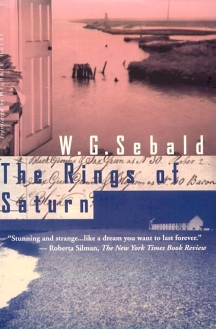
The following extract is from W G Sebald's The Rings of Saturn. This is actually taken from the notebooks of nineteenth century French writer and memoirist Chateaubriand, whom Sebald (or the narrator), quite clearly finds a kindred spirit.

But the fact is that writing is the only way in which I am able to cope with memories which overwhelm me so frequently and so unexpectedly. If they remained locked away, they would become heavier and heavier as time went on, so that in the end I would succumb under their mounting weight. Memories lie slumbering within us for months and years quietly proliferating, until they are woken by some trifle and in some strange way blind us to life. How often this has caused me to feel that my memories and the labours expended in writing them down are all part of the same humiliating and, at bottom, contemptible business! And yet, what would we be without memory? We would not be capable of order the simplest thoughts, the most sensitive heart would lose the ability to show affection, our existence would be a never ending chain of meaningless moments, and there would not be the faintest trace of past. How wretched this life of ours is!--so full of false conceits, so futile, that it is little more than the shadow of chimeras loosed by memory.


I am trying to write something on the connection between Sebald and Nabokov. My curiosity has been piqued after reading this passage (although Nabokov is much more benign when it comes to describing the tyrannies of memories) and Sebald's essay on Nabokov's Speak, Memory in his latest essay collection Campo Santo. But it needs some more thinking and some more time.

Previous posts on The Rings of Saturn here and here.

On Speak, Memory.

Some quotes from the book:
The Cradle Rocks above an Abyss
Death, A Shameful Family Secret?

Robert Burton on Crystallization

Robert Burton of The Anatomy of Melancholy has this to say on the topic of crystallization. More on the topic a little later.

Every lover admires his mistress, though she be very deformed of herself, ill-favoured, wrinkled, pimpled, pale, red, yellow, tanned, tallow-faced, have a swollen juggler's platter face, or a thin, lean, chitty face, have clouds in her face, be crooked, dry, bald, goggle-eyed, blear-eyed, or with staring eyes, she looks like a squis'd cat, hold her head still awry, heavy, dull, hollow-eyed, black or yellow about the eyes, or squint-eyed, sparrow-mouthed, Persian hook-nosed, have a sharp fox-nose, a red nose, China flat, great nose, nare simo patuloque [snub and flat nose], a nose like a promontory, gubber-tushed, rotten teeth, black, uneven brown teeth, beetle-browed, a witch's beard, her breath stink all over the room, her nose drop winter and summer, with a Bavarian poke under her chin, a sharp chin, lave-eared, with a long crane's neck, which stands awry too, pendulis mammis, "her dugs like two double jugs," or else no dugs, in that other extreme . . . a vast virago, or an ugly tit, a slug, a fat fustilugs, a truss, a long lean rawbone, a skeleton, a sneaker (si qua latent meliora puta) [think that what is not seen is better], and to thy judgment looks like a mard in a lanthorn, whom thou couldst not fancy for a world.


I don't know if there is a better example of decriptive writing than this.

Tuesday, June 14, 2005

The New Existential Thriller from Hungary


This Saturday, I saw this new "existential thriller" from Hungary called Kontroll, which was the most popular film in Hungary in the last year and which had won sundry awards here and there including a selection in the Un Certain Regard section of the Cannes Film Festival.

The indication that the film is not a regular thriller but an existential or a metaphysical one comes even before the start of the film itself, when a character, who identifies himself as chief of Budapest Subway System, reads a printed disclaimer in a thoroughly deadpan voice, which is actually quite hilarious. He says, rather predictably, that the film is fictional and doesn't reflect the realities of the subway system and then adds that everything is "obviously symbolic" and the young director was permitted to make the film only because he wanted to make a film about "good and evil" and not about the subway system.

In the next two hours Kontroll never leaves the dark and dank netherworld of the subway system, with its fluorescent lightings, sounds of trains whooshing past one another and all kinds of eccentric and grotesque characters embarking and disembarking from the trains. The eccentricities, in a way, and together with highly stylized lighting and dynamic steadicam camera work enforce the surrealistic credentials of the film. These eccentrics include not only the commuters, who form a rag-tag bunch of hostile punks and abusive tarts with their pimps, but also the Kontrollers , or the ticket checkers. One of those eccentric ticket checkers is our hero, who is rather good looking but who, it seems, hasn't slept in weeks. As it turns out he has been sleeping, if at all he does, on the platforms and prowling the labyrinthine tunnels in the night all alone, or perhaps not. There is a mysterious hooded figure, who keeps cropping up, almost supernaturally, to push innocent bystanders on the tracks, into the way of oncoming trains. The hooded figure is perhaps the hero's double, his evil side, although it is never made very clear in the film. Finally our hero meets his angel who wears a bear costume all the time but in the final scene in an obviously symbolic scene comes dressed with wings and takes the hero out of subway to light after he is done with the evil one. This good triumphs over evil. It was overall a nice fairy tale.

The "message" of the film (lonely-hero-finds-salvation-in-a-beautiful-angel-and-escapes-netherworld) is, of course, very trite and I am not sure even the director wants us to take it seriously. On the other hand, what interests the first time director Nimrod Antal is the creation of atmosphere and mood, which he does perfectly. Equally attention-grabbing is the heart-pounding techno-rock sound score by some music outfit called Neo (inspired by Matrix?). The music reminded me of Run Lola Run which belongs to the same MTV, hipster school of film making as this one does.

Roger Ebert talks about the film here and Jim Hoberman here.

Sunday, June 12, 2005

The Anatomy of Melancholy


The latest issue of New York Review of Books has an essay on Robert Burton's The Anatomy of Melancholy, the sixteenth century classic study of, mainly Melancholy, but also every other thing on the planet. I first came to know about the book after reading an article in The Guardian about it. Nicholas Lezard in his short paperback-of-the-week column says:

Paperback not so much of the week as of the year, of the decade -- or, I am inclined to say, of all time. And why ? Because it's the best book ever written, that's why. I use the word "book" with care. It's not a novel, a tract, an epic poem, a history; it is, quite self-consciously, the book to end all books.


I later came to know more about the book and no reference of the book that I found anywhere were without the wildest superlatives imaginable, just as in the Guardian article above. This book is at the top of the Complete Review best books list. Check out its book page here.

So, when I saw the book mentioned on the front page of the New York Review I decided to pick up the copy. And the essay is quite delightful, although a trifle disappointing (at least to me) because the reviewer spends most of the time discussing medicinal history and the stylistics of sixteenth century English prose and not the nature of melancholy itself. Although when he briefly touches this aspect, it is not without some great insight. The quotes from the book are alone worth reading the entire essay. As here when Burton is lamenting the complexities and mysteries of the melancholy temperament and heart:

Who can sufficiently speak of these symptoms, or prescribe rules to comprehend them?... If you will describe melancholy, describe a fantastical conceit, a corrupt imagination, vain thoughts and different, without which who can do? The four and twenty letters [of the alphabet] make no more variety of words in diverse languages, than melancholy conceits produce diversity of symptoms in several persons. They are irregular, obscure, various, so infinite, Proteus himself is not so diverse, you may well make the moon a new coat, as a true character of melancholy man; as soon find the motion of a bird in the air, as the heart of a man, a melancholy man.


As noted by the reviewer, what actually makes The Anatomy a work of literature, rather than simply a dense medical and philosophical treatise, is Burton's ability to transcend the specificities of medicinal aspects to reach some profound understanding of the general human condition. Although he does it by looking at everything through the prism of melancholy:

And who is not a fool, who is free from Melancholy? Who is not touched more or less in habit or disposition?... And who is not sick, or ill-disposed,in whom do not passion, anger, envy, discontent, fear and sorrow reign?


What I found most interesting in the article was a discussion of the ways in which Melancholy was viewed throughout history. In sixteenth and seventeenth century, an affectation of melancholy was a favourite pose for those who made claim to a superior refinement, a noble spirit and a sensitive, poetic heart. The somber delights of melancholy were generally supposed to outweigh its anguish and misery. Keats even composed an Ode on Melancholy and Burton himself opens his book with a poem which enumerates all its lugubrious pleasures ("naught so sweet as melancholy"). There are innumerable passages from Byron (most memorably from Manfred, my all time favourite English poem) which also explore and celebrate similar mental states.

After Burton, the term lost its poetical, personal meaning and got subsumed into a larger word ennui, or boredom, which had more sociological and impersonal import than the previous meaning. Most of the greatest works of nineteenth century literature capture this meaning quite truthfully. Julien Sorel's quest, in Stendhal's Red and Black, is to find that abstract thing called Happiness (the novel, by the way, is dedicated to "the happy few") but in more concrete terms it is its inverse -- quest to find some way to escape from boredom. All his amorous conquests, love affairs and political machinations, at the most basic level, are means to escape the boredom of small-town, petit-bourgeois life. And talking of the boredom of provincial life who can forget Madame Bovary and its creator Flaubert, who would himself, as his greatest creation, have definitely fit the description of a melancholy man perfectly. The great Russian novels of nineteenth century also explore this with great success. They even coined a new term for this kind of personality; they called it "the superfluous men". The anarchists and rebels in Dostoevsky's novels are not the idealistic young men that they think they are, they are merely a confused lot who have read lots of romantic literature and philosophy (Byron was very popular in Russia at that time) and want to escape the boredom of their lives. Lermontov's A Hero of Our Time clarifies some of these themes in its title itself. Here is a nice article on the book and an extract:

Pechorin, the hero, is a strong, silent man with a poetic soul who, either from shyness or a contempt for the herd, especially the aristocratic herd, assumes the mask of a snob and a bully. Unlike the classic type of "superfluous men" who opt out of society, Pechorin is a strong character at odds with the world. He is proud, ambitious, strong-willed but having found that life does not measure up to his expectation of it, he has grown embittered, cynical and bored. At the age of 25 (as he is in the book) he has experienced all that life has to offer and found nothing that gives him more than a passing satisfaction or interest. He sees that life has let him down, failed to provide for him some cause that would be worthy of his superior powers. So, he is reduced to dissipating his considerable energies to petty adventures. And he embarks on his adventures with no illusions that he was doing no more than a temporary escape from boredom.


The essential characteristics of boredom as depicted in these great works of literature were an alienation from the society, because of the superiority of refinement and spirit, a deep sensitivity of the heart and disgust at the vulgarities of bourgeois life (Flaubert and Homais come to mind). The word soon took on a grand meaning of, not just a void of interest or a sophisticated indifference, but a dissatisfaction with the world, with civilization. And with this last thing we enter into modern literature and its profoundly pessimistic world, of Proust for example. The following passage excerpted in the article from somewhere else is so Proustian, in its description of pervading ennui and in its profound and final devastating insight into the human condition:

Yesterday evening I admired the numerous guests who were at my house; men and women like machines with springs who came and went, spoke and laughed, without thinking, without reflecting, without feeling; each one played his role through habit; Madame de Duchess of Aiguillon burst with laughter, Mme De Forcalquier showed her disdain for everything. Mme de la Valliere jabbered about everything. The men were no better, and as for myself, I was buried in the deepest reflections; I thought that I had passed my life in illusions; that I had hollowed out for myself all the abysses into which I had fallen; that all my judgments were false and rash and always too precipitate; and finally that I had never really known anyone, that I had never been known, and that perhaps I did not know myself.


This is perhaps the reason why melancholy has been able to retain a curious if perverse fascination for writers and thinkers throughout the history of human civilization and I can now understand all the superlative adjectives that writers and scholars heap on a book like this. Because they know what Burton is saying is true. But with all the "somber delights" that a melancholy heart offers, Burton also warns the ingenuous readers not to fall for its perverse charms just for its own sake. As he says, "For the unhappy few, melancholy could be irresistible". Yes, indeed.

Friday, June 10, 2005

The Greatest Film Ever Made...

...is Tokyo Story, directed by the gentle nihilist of Japanese Cinema, Yasujiro Ozu. The honour of promoting the film to the top spot goes to Halliwell film guide.

This is the only Ozu film I have seen so far, but I can't wait to see more. I will write about the film in detail sometime. Till then I will let you read Peter Bradshaw of The Observer:

It is certainly his masterpiece: tender, profoundly mysterious and desperately sad. But its exquisite melancholy is not derived from something esoteric or exotic, but a very real human anxiety, instantly comprehensible. How do we look after our elderly parents as they confront imminent death? How far can we afford to expose ourselves to their secret pain and fear? And when it is our turn to grow old, can we expect our children to share the burden?


This article says, "in many ways he was a pessimist".

In many ways Ozu was a pessimist - he saw life changing for the worse, the Japanese losing traditional values, children tolerating rather than loving their parents.


Actually he was much more than a simple pessimist. He was a nihilist, but his nihilism is not tinged with bitterness or anger at all, rather it reflects a mature, deeper and stoical, although melancholy acceptance of the profound truth of the meaningless and nothingness of life. Although all his films are family dramas, he himself never married or had any children. In fact he was so certain of the futility of everything that he even had the Chinese symbol for nothingness engraved on his tombstone. Now that's what is called living by what you believe in. Great artist. Great man.

Thursday, June 09, 2005

Self-Abuse or Self-Discovery?


Well, both. Can you guess what Proust is talking of in these lines?

Alas, it was in vain that I implored the dungeon-keep of Roussainville, that I begged it to send out to meet me some daughter of its village, appealing to it as to the sole confidant to whom I had disclosed my earliest desire when, from the top floor of our house at Combray, from the little room that smelt of orris-root, I had peered out and seen nothing but its tower, framed in the square of the half-opened window, while, with the heroic scruples of a traveller setting forth for unknown climes, or of a desperate wretch hesitating on the verge of self-destruction, faint with emotion, I explored, across the bounds of my own experience, an untrodden path which, I believed, might lead me to my death, even until passion spent itself and left me shuddering among the sprays of flowering currant which, creeping in through the window, tumbled all about my body. In vain I called upon it now. In vain I compressed the whole landscape into my field of vision, draining it with an exhaustive gaze which sought to extract from it a female creature.


This passage occurs near the end of the second chapter of Swann's Way called Combray. Like a careless and anxious reader who wants to finish a book as fast as possible so that he can jump to the next one, I totally failed to understand what the narrator was actually describing in the passage. I thought, okay, so Proust is describing the idea of solipsism and romanticism and how sensations and perceptions are the best tools with which we can unravel our identities and then I moved ahead. I would have definitely got a zero in Nabokov's course. I always look for general ideas in literature and always tend to ignore or undervalue specific details. But then, I came across this essay in New York Review of Books (God bless these critics!) and found out what that "untrodden path" actually was (scroll down to the bottom to get to the aforementioned passage and its discussion). That's why I always say, Proust should be in high-school syllabus all over. If kids could only read this before exploring their own untrodden paths and unknown climes!

Wednesday, June 08, 2005

Love: A Reading List

I had one more interaction with Michael Dirda in this week's discussion. He didn't answer my first question, but he suggested some further readings. Perhaps I should get hold of the complete reading list that he used for his course on "Love". Yes, he took a course on the subject in some university! Here is the question and the response:

Chicago, IL: I am currently reading Stendhal's amusing reflections on Love called simply "Love". First, do you know if Proust had read this book or if he did, what did he think of it? I find so many similarities between the two writers' approaches to the dissection of love. Second, do you know of any other similar book from the canon on this subject (non-fiction, amusing, witty and unsentimental)?

Michael Dirda: Yes, I know De L'Amour, being a Beyliste from way back, and having had my students read it this past spring for my Love class. No jokes please.

Other books on love? You might look for a book of essays by Ortega Y Gasset, try Mario Praz's The Romantic Agony, or--most famous of all, with a thesis that has been influential but controversial--Denis De Rougemont's Love in the Western World.


Hmmmm, The Romantic Agony sounds very interesting. Just in case you are opening a dictionary to find out what Dirda meant when he called himself "Beyliste", here is a clarification: Stendhal's real name was Henri Beyle and Dirda, of course, is very fond of him. In fact after reading half each of The Red and the Black and Love I have started admiring him a lot too. More posts on Stendhal will follow.

Love, an Intransitive Verb?

The dictionary says it is. But what does it mean for "love" to be intransitive? Curiosity aroused after reading this.

Monday, June 06, 2005

Depressing Poem for a Depressing Day

Is there a better way to wallow in misery, self-pity and depression than reading Philip Larkin on Life and Death?

From his famous poem Aubade:

I work all day, and get half-drunk at night.
Waking at four to soundless dark, I stare.
In time the curtain-edges will grow light.
Till then I see what's really always there:
Unresting death, a whole day nearer now,
Making all thought impossible but how
And where and when I shall myself die.
Arid interrogation: yet the dread
Of dying, and being dead,
Flashes afresh to hold and horrify.

The mind blanks at the glare. Not in remorse
-- The good not done, the love not given, time
Torn off unused -- nor wretchedly because
An only life can take so long to climb
Clear of its wrong beginnings, and may never;
But at the total emptiness for ever,
The sure extinction that we travel to
And shall be lost in always. Not to be here,
Not to be anywhere,
And soon; nothing more terrible, nothing more true.

This is a special way of being afraid
No trick dispels. Religion used to try,
That vast moth-eaten musical brocade
Created to pretend we never die,
And specious stuff that says No rational being
Can fear a thing it will not feel, not seeing
That this is what we fear -- no sight, no sound,
No touch or taste or smell, nothing to think with,
Nothing to love or link with,
The anaesthetic from which none come round.

And so it stays just on the edge of vision,
A small unfocused blur, a standing chill
That slows each impulse down to indecision.
Most things may never happen: this one will,
And realisation of it rages out
In furnace-fear when we are caught without
People or drink. Courage is no good:
It means not scaring others. Being brave
Lets no one off the grave.
Death is no different whined at than withstood.

Slowly light strengthens, and the room takes shape.
It stands plain as a wardrobe, what we know,
Have always known, know that we can't escape,
Yet can't accept. One side will have to go.
Meanwhile telephones crouch, getting ready to ring
In locked-up offices, and all the uncaring
Intricate rented world begins to rouse.
The sky is white as clay, with no sun.
Work has to be done.
Postmen like doctors go from house to house.

Saturday, June 04, 2005

Nabokov's Strong Opinions


Nabokov, just as he is famous for the great books he wrote, is equally known for his arrogant, olympian disdain and aristocratic dismissal of some of the greatest names in literature, many his contemporaries but also the writers of the past and well entrenched in the canon (he called Cervantes a cruel sadist). What is specially delightful about reading his interviews and comments is the way in which he goes about doing the demolition job. He obviously relishes it and somehow as a reader I always find something very charming in his arrogance, even when he is speaking about some of my favourite writers. For example, here is Nabokov on Dostoevsky:

Dostoevski, who dealt with themes accepted by most readers as universal in both scope and significance, is considered one of the world's great authors. Yet you have described him as "a cheap sensationalist, clumsy and vulgar." Why?

Non-Russian readers do not realize two things: that not all Russians love Dostoevski as much as Americans do, and that most of those Russians who do, venerate him as a mystic and not as an artist. He was a prophet, a claptrap journalist and a slapdash comedian. I admit that some of his scenes, some of his tremendous, farcical rows are extraordinarily amusing. But his sensitive murderers and soulful prostitutes are not to be endured for one moment-- by this reader anyway.


And another outburst on Dostoevsky:

Dostoevski the publicist is one of those megaphones of elephantine platitudes (still heard today), the roar of which so ridiculously demotes Shakespeare and Pushkin to the vague level of all the plaster idols of academic tradition, from Cervantes to George Eliot (not to speak of the crumbling Manns and Faulkners of our times).


Here is another example, where he dismisses one writer after the other (including our own Tagore--"a person called Tagore", sigh!). He obviously never found any value in having a literary circle of his own. Good for him.

Because of your mastery of our language, you are frequently compared with Joseph Conrad.

Well, I'll put it this way. When a boy, I was a voracious reader, as all boy writers seem to be, and between 8 and 14 I used to enjoy tremendously the romantic productions-- romantic in the large sense-- of such people as Conan Doyle, Kipling, Joseph Conrad, Chesterton, Oscar Wilde, and other authors who are essentially writers for very young people. But as I have well said somewhere before, I differ from Joseph Conradically. First of ail, he had not been writing in his native tongue before he became an English writer, and secondly, I cannot stand today his polished cliches and primitive clashes. He once wrote that he preferred Mrs. Garnett's translation of Anna Karenin to the original! This makes one dream-- "ca fait rever" as Flaubert used to say when faced with some abysmal stupidity. Ever since the days when such formidable mediocrities as Galsworthy, Dreiser, a person called Tagore, another called Maxim Gorky, a third called Romain Rolland, used to be accepted as geniuses, I have been perplexed and amused by fabricated notions about so-called "great books". That, for instance, Mann's asinine Death in Venice or Pasternak's melodramatic and vilely written Zhivago or Faulkner's corncobby chronicles can be considered "masterpieces," or at least what journalists call "great books," is to me an absurd delusion, as when a hypnotized person makes love to a chair. My greatest masterpieces of twentieth century prose are, in this order: Joyce's Ulysses,Kafka's Transformation, Biely's Petersburg, and the first half of Proust's fairy tale In Search of Lost Time.


Nabokov defining Poshlost is the most hilarious of all but I will save that for another post.

Kira Muratova's Chekhovian Motifs

Sometime back, while browsing at a bookstore, I came across this delightful recommendation on the back of Andrei Bely's symbolist-surrealist, Russian masterpiece Petersburg (I didn't buy the book): "All people who go in for the B's--Beckett, Brecht, Bunuel--better get hold of Bely. He came first, and he is still the best." This quote again came to my mind after I finished watching Chekhovian Motifs, Kira Muratova's third film that I saw at the film center last weekend, because in this film (and indeed, her other films), she has somehow managed to fuse together all the three B's together. The absurdist, the ironist and the surrealist all fuse together in her film and the result is a delightful cocktail, although the same would not be for all the tastes.

This film continues in the same vein of dark, surrealistic satire on social and familial institutions in Russia, just like its precursors The Asthenic Syndrome and Three Stories did, although the humour is a little stronger this time. The film is based, as the title makes clear, on some obscure early works of Chekhov, which of course I have not read, but whatever little that I know of Chekhov's fiction, I can surely say that the great man would not have imagined even in his wildest dreams the kind of characters, situations and mood that Muratova has managed to create apparently from his work as if by some magical sleight of hand. The film starts with what would arguably be the strangest family dinner scene in film history. The eldest son of the family is going to Moscow to continue his studies and wants some money from his father, which his father, a penny-pincher that he is, refuses to give. His mother starts pleading, and her pleas are repeated at least half-a-dozen times all in the same words and same tone. In the meanwhile the two younger brothers start arguing about something and the youngest one falls asleep on the table! The father, as indeed the audience, gets exasperated with all this and reacts in a wildly over-the-top manner. The son then walks out of the house after giving his father a piece of his mind and sets off on the road, dreaming of dying of hunger and making it to the newspapers the next day (as her sister suggests him to do!).

On his way the son stumbles into a wedding party at a church, which is again one of the weirdest wedding scene in the film history. All the rituals of the Russian orthodox church are shown in excruciating detail while the guests, all vulgar brutes, start getting bored and continue with their gossip. After the party is over one of the junior priests sermonizes in a detached tone: "All is in vain. They keep singing, burning incense and praying, but God still refuses to hearken unto them. I've been serving here for forty years, and God has not heard them, not on a single occasion… I have no idea, where this God is..." In the end the son goes back to his home where his father gives him the money that he wanted and that's where the film ends.

The film is of course a masterpiece in the sense that the formal experimentation that Muratova indulges in, is not used for its own sake, but it is used for providing a critique of existing social and political mores, which is what all great art should do. It's a pity that Kira Muratova is not widely known. Her startling and bold vision, although too dark and pessimistic for some, still is unique among the contemporary film makers and so is worth popularising among the serious film-going public. So here are a few resources in case you are too lazy to google. This is a brief overview of her career so far by Senses of Cinema. Here is one of her interviews. Very predictably she says: "What is most important to me, is to please myself." Worth reading also are the articles by Chris Fujiwara and Jonathan Rosenbaum. Rosenbaum on Asthenic Syndrome here. And finally the film center booklet where I saw these films.

Friday, June 03, 2005

Stendhal and Nabokov

Michael Dirda is one of the best literary essayist out there. He is a senior literary editor at the Washington Post newspaper. Every week he participates in a discussion, where he answers readers' questions. This week I stumbled into his discussion at just the right time, and since my literary landscape is clouded by Nabokov and Stendhal these days, I asked him the most obvious question, and here is what the answer was:

Alok, Chicago, IL: Interesting to see Stendhal sitting side by side Nabokov on your favourite writers list. What do you think of Nabokov's comment, when he called Stendhal's novels "fiction for the chambermaids" ? Don't you think Stendhal's fiction is a little too "easy", a little too "racy" to be ranked with other great literature?

Michael Dirda: No. He is the greatest all round French writer--author of two of the top 20 French novels, author of a highly original autobiography (Vie de Henry Brulard), a superb travel writer, and as inimitable a presence on the page as any writer you'll ever meet. By comparison, Nabokov is nothing but a stylist. A great stylist, yes, but in a fairly narrow vein.

Wednesday, June 01, 2005

Invitation from the Proust Society of America

This is the invitation I got with my Proust newsletter:

If you plan to be in New York City on July 9th, please join The Proust Society of America at our Proust Fest 2005: Swann's Song.

To celebrate the 134th birthday of Marcel Proust, on July 9, 2005 the Proust Society and the Mercantile Library of New York will sponsor an all-day, public reading in English of Swann in Love. Members of the Proust Society, noted authors, and invited celebrities will read Proust's famous account of the passionate and complex love affair between Charles Swann and Odette de Crecy. The reading will begin at 10 a.m. at the Mercantile Library and conclude around 11 p.m. Madeleines from Payard and tea will be available. Admission, $5.00. For more information, visit our Web site, Reservations required. Call 1(212) 755-6510. Mercantile Library, 17 East 47th Street (between Fifth Avenue and Madison Avenue)

A Note on Rilke

I have read only bits and fragments of Rilke's poetry and his Duino Elegies is high up on my reading list ever since I came across the opening lines of the poem, the brilliant, heart-rending wail of loneliness: "Who, if I cried out, would hear me among the angelic orders?"

I had no idea of what kind of life Rilke lead, but I had assumed him to be a sensitive young man disappointed with all the banal cruelties of life as perhaps all poets are. But this review by Michael Dirda of Washington Post clarified some of the details. And it is not a pretty sight if you believe what he says:

Any fervent admirer of Rainer Maria Rilke (1875-1926) -- regarded by many as the greatest European poet of the century -- would do well to avoid Ralph Freedman's enormously detailed and scrupulously researched biography: On page after page it portrays one of the most repugnant human beings in literary history. As John Berryman so aptly put it: "Rilke was a jerk."

Many writers may be eccentrics, isolators and obsessives, but they usually retain at least one or two admirable qualities aside from their devotion to art: Think of Joyce's and Nabokov's love of family, Flaubert's stringent work ethic, Zola's political courage, James's kindliness. Even the most problematic moderns -- such as Pound and Celine -- can earn our sometimes grudging sympathy. But Rilke the man is hard to pardon or excuse.

Paradoxically, though, the author of the Duino Elegies and the Sonnets to Orpheus (both 1923) has long been viewed as a saint of modern art, a man who dwelt alone in a perpetual solitude of the soul, who made himself into a sensitive Aeolian harp for the shifting winds of poetry. Yes, he was ruthless to others as he was to himself and yes, he shamelessly flattered rich aristos, but a poet has to live somehow. Isn't "Orpheus. Euridice. Hermes" worth a few broken hearts and a heap of rich women's gold?

A tricky question.Yet Life of a Poet makes clear that this hollow-eyed communer with angels, Greek torsos and death was not merely a selfish snob; he was also an anti-Semite, a coward, a psychic vampire, a crybaby. He was a son who refused to go to his dying father's bedside, a husband who exploited and abandoned his wife, a father who almost never saw his daughter and who even stole from a special fund for her education to pay for his first-class hotel rooms. He was a seducer of other men's wives, a pampered intellectual gigolo, and a virtual parody of the soulful artiste who deems himself superior to ordinary people because he is so tenderly sensitive, a delicate blossom easily punished by a passing breeze or sudden frost.

Death: A Shameful Family Secret?

More from Speak, Memory :

Whenever in my dreams, I see the dead, they always appear silent, bothered, strangely depressed, quite unlike their dear bright selves. I am aware of them, without any astonishment, in surroundings they never visited during their earthly existence, in the house of some friend of mine they never knew. They sit apart, frowning at the floor, as if death were a dark taint, a shameful family secret. It is certainly not then—not in the dreams—but when one is wide awake, at moments of robust joy and achievement, on the highest terrace of consciousness, that mortality has a chance to peer beyond its own limits, from the mast, from the past and its castle-tower. And although nothing much can be seen through the mist, there is somehow the blissful feeling that one is looking in the right direction.