David Lynch Interview
A nice short interview of David Lynch about last year's exhibition of his art works:
A nice short interview of David Lynch about last year's exhibition of his art works:
 I was reading Midnight Movies co-authored by Jim Hoberman and Jonathan Rosenbaum. I will probably have more to say about it sometime later. For now something that got me into thinking. This is from the afterword which they wrote on occasion of the 20th anniversary of its publication.
JR: I have to admit that I'm a Twin Peaks addict myself. But there's more commercial than artistic logic in the way Lynch's career has developed. He's gone from making introverted movies to making extroverted ones--a downhill path culminating in Wild at Heart. Blue Velvet was the turning point, the transformation of unconscious camp into conscious camp. I tend to think that some of film's kitschier ideas--the robins as harbingers of love, for example--were sincere. But when these notions were seen as funny, Lynch began using them more systematically, with a certain calculation. By the time you get to Wild at Heart, the whole notion of sincerity seems to exist between quotation marks. The citation of Elvis and The Wizard of Oz are substitutes for feeling and imagination.
JH: Another way of positioning himself in the American mainstream.
JR: It's also postmodernism--the placing of everything between quotation marks. Postmodernism is not only our dominant culture now, but in some ways, it's our only culture. You might say that as auteurism turned junk into art, postmodernism turns art into junk. Even when an original artist like Lynch appears, it's not long before he starts quoting himself, using his work in a postmodernist way. Agent Cooper's dream in Twin Peaks is like recycled, simplified Eraserhead. Lynch's development parallels the go-for-broke ecological and economic philosophy of Reagan years. You burn up the ground under your feet and you basically use up whatever you've got.
****
Another article which discusses postmodernism in the context of Blue Velvet here.
As I was reading the essay on Eraserhead and the subsequent dialogue I found myself disagreeing with what Rosenbaum says. The postmodernism in Lynch is not just empty play of signs and signifiers but as he himself concedes, talking about the scene with the robins in Blue Velvet, there is an element of sincerity in those hyper-real and apparently kitschy images as well. The way he achieves this delicate balance is exactly what makes his films so different and unique and it is present in every one of his films Blue Velvet onwards. He is particularly harsh on Wild at Heart but even there while it is obvious that the characters of Sailor and Lula are not really characters but archetypes, totally artificial mixture of bricolage from American popular culture-scape, their feelings for each other do come across as genuine and sincere. Rosenbaum's criticism will be more valid for directors like Tarantino who are truly postmodernist, in the sense that their films are nothing but intertextuality and pastiche, and in the end resulting in arid wastelands of meaningless images, signs which point only to other signs, refusing to tie them back to anything outside the film itself and I can understand if someone sees it as a cultural crisis.
Some other recent films which strike this balance successfully are Todd Haynes's Far From Heaven and Lars von Trier's Breaking the Waves. I love them both.
"Albert's path is a strange and difficult one"
Here's Albert's entry into Twin Peaks and more here.
Meanwhile David Lynch has got himself into some trouble in Germany. I so wish he were spending more of his time and energy making films.
A great scene from Twin Peaks, one of my favourites. Something very horrible has just happened and all these people can already feel it...
The words in the song are of David Lynch (Dust is dancing in the space/Dogs and Birds are far away). The music by Angelo Badalamenti and it is sung by Julee Cruise, featured in the video too.
Another nice song from Twin Peaks by the same team, "Into the Night" here. No clips from Twin Peaks though.

The New York Times talks about a new documentary about David Lynch. It is compiled from footage collected over two years as he worked on his latest film Inland Empire. From the reviews it sounds like for fanboys only. Other reviews from village voice and slant. Trailer here.

News that may be of interest to fellow David Lynch fans. Inland Empire DVD is soon out and extras include a 75 minute feature titled "Other Things That Happened"!
from here

Saw Inland Empire for the second time yesterday. I think it can be classified as a work of feminist surrealism (or surrealist feminism). It basically is "about" (and I use the word very loosely) women (or perhaps a single woman) having nightmares about being a whore. It is not really an original idea. (The Austrian writer Arthur Schnitzler's novella Fraulein Else, which I read recently, tells the story of a young teenaged girl, told in the form of an unbroken monologue, who suffers a nervous breakdown thinking that she has turned into a whore when she is just following the rules and orders of her parents and people around her.) There are also a couple of separate nightmares which are not really connected with the whore-nightmare but are the same in terms of the basic idea. The adultery sub-plot of film-within-a-film is basically a reworking of standard adultery narratives, which shows how far the stacks are laid against women as compared to men when it comes to the whole adultery business. Also the violent monologue is again the woman's subconscious speaking out -- all the latent resentments against her lover/husband/client coming out with extreme brute force. I should have copied out some of the dialogues. It is actually very funny. IMDB has only a couple:
Nikki: When the police came and they asked what happened, I told them "He's reaping what he's been sowing, that's what." They said "Fucker been sowing some pretty heavy shit."
Nikki: Bam! I Kicked him straight in the balls so hard they go crawling into his brain for refuge - he went down like a two dollar whore.
Such a shame, Dern wasn't even nominated for an Oscar!
The Polish sequences can also be fitted in the same basic narrative. Violence, Abuse, Adultery etc. Okay, talking rabbits? I don't really know about that. Who is the girl crying watching the TV? Not really sure. And there are so many other things too. Will have to wait for the DVD to come.
Nice David Lynch parody. Make sure the sound is on and preferably high, also mandatory for Lynch's movies.
And the introduction to Twin Peaks TV series, it is wonderful...
And the "Tibet scene" from the first season. May not make sense to people who haven't seen but still quite good... Also a nice illustration of how Lynch makes fun of the traditional detective Genre with its emphasis on logic and rationalism...
French trailer of Inland Empire. It is nicer and slightly longer than the official American version.
btw, this guardian blog is asking what it is about? I am going to see it again this weekend. Will take notes this time.

BBC has reports from the exhibition of David Lynch's visual works currently on in Paris here and here.
The Guardian has a more detailed report here. The above photograph taken from the telegraph.
On the topic of David Lynch, here is a review of Lost Highway Opera (which I didn't attend). Austrian nobel laureate Elfriede Jelinek wrote the libretto. I wonder what it is!
 Cahiers du Cinema, the world's most famous film journal, is now available in electronic format (I mean with simulation of print copy and everything and translated into English!) There are lots of goodies for David Lynch fans. If you are one of the heathens the essays and reviews might piss you off. They are a slightly over the top in their praise for his work. There is also an exhibition of David Lynch's paintings and graphic work currently on in Paris. There are images from that too.
Also lots of Lynch related links on this blog.
Also Girish has excerpted an article about the history of the Journal on his blog. There is a nice discussion in the comments section too.
Also I am planning to re-watch Inland Empire when it gets released into the neighbourhood theatre. (I just saw the posters, I don't know the dates.) This time I will try to take down some mental notes. Of course, if you are in New York you can trek down to the IFC Center where it is still going strong after three months since its release.
Update:Greencine Daily points to another magazine which has Lynch on its cover.
 David Lynch is now on London tour with his Inland Empire. The Guardian has a transcript of the interview conducted at the NFT. Has this interesting information in particular.. he asks his polish visitors, "if they could get me nude women at night to photograph." (the film has some scenes of nude polish prostitutes singing pop songs!)
Q10: What is it about Poland that made you decide to film Inland Empire there, and with Polish actors as well?
DL: A car arrived and five or six guys get out and come into my house. And they're from Lodz, Poland, and they say they're from the Camerimage film festival. They're the greatest bunch, these guys who run the festival, the hardest workers. They've been putting on this festival for 14 or 15 years now, on their own against all odds and it gets bigger and bigger every year. Really beautiful. They invited me over there and I asked them if I went there, because I heard there were factories, so I asked if they could get me into factories so that I could photograph, and if they could get me nude women at night to photograph.

Golden Globes nominations are out and not surprisingly David Lynch's Inland Empire is nowhere to be see, which is not really surprising to be honest. Lynch's film feels more like a video installation art rather than a full length feature film. Lynch surely won't win any new fans with it but his loyal devotees will not be disappointed. He is on the same track, it is just that he has taken a few steps forward, or deeper towards the "inland". All the familiar Lynchian tropes are there and one of the thing about watching it is identifying them, so you see red curtains, flickering bulbs, omnipresent buzz on soundtrack and hints about something mysterious and monstrous lurking in every nook and corner and then you nod in approval!
Perhaps the most written and talked about aspect of the film is that it was shot in digital video using a consumer grade camera. So the sensuousness and the texture of Blue Velvet or Mulholland Dr. is missing. Instead we get Lars von Trier like grainy look with seemingly adhoc compositions. It is jarring initially but you get used to it as the film goes on. There are though too many facial closeups throughout the film. I think he could have avoided it, somehow it didn't feel right, it just looked ugly.
I didn't say anything about what the film is actually about. Hmmm. That's tough, but let me try. There is this actress played by Laura Dern (the innocent blonde from Blue Velvet) who is acting in a movie based on a polish folk tale. There was earlier a german movie planned but the cast and the crew were mysteriously murdered. So anyway, the shooting starts and soon the reality and illusion, outside and inside start to merge and become inseparable. Lynch isn't interested in the familiar gotcha (hey, it was only a movie!) scenes familiar to so many film-within-a-film genre just like he isn't interested in hey-it-was-only-a-dream moments in his other narratives. He is interested in character's fractured subjectivity and its representation through innovative narratives. And yes, I forgot there is a family of people with talking rabbit heads who talk in non-sequiturs, there are a bunch of polish prostitutes and I think I saw a few monsters too, I am not sure, may be I was just dreaming!
Reviews by sharper and more intelligent people won't help either but you can try Rotten Tomatoes. Not surprisingly it has got lots of thumbs down. Though I was surprised to see the turnout at the ifc center where the film is currently running. I think only one person walked out before the end. Rest of them stayed through the end credit sequence too which features a wonderful song with some surprise guest appearances. The film is not getting a wide release. Besides New York, there are only a few cities and even there you won't find it anywhere near those ugly and monstrous multiplexes. (Full theatrical schedule here.)
A nice long interview of Lynch on Youtube. It is old and an hour long, other parts are on the right sidebar. He is a really goofy fellow (he says he gets his ideas from the "ether" where they float).
This is a nice profile and interview of David Lynch from the new york times. I feel annoyed of not getting the tickets for Inland Empire. All the screenings (which means two screenings in total) were sold out in the first few days itself. Ditto for Volver. Almodovar's movie is going to get a wide and mainstream release soon but can't say the same about Lynch's. The film doesn't have any distributor yet and there are no dates, no publicity campaign, no website, nothing at all. Which means that it will perhaps not be released anytime soon, if at all it gets released.
New York, supposedly the film capital of the world, at least after Paris, why can't its premier film festival have more screenings? Is it something to do with being "insanely selective" (I hope you saw the promotional ad for the nyff here), about the audience I mean?
By the way on the same topic, here's a great essay on Twin Peaks, at least that's what it looks like since I haven't read it yet. It goes really deep and wide about it (invoking Dante!).
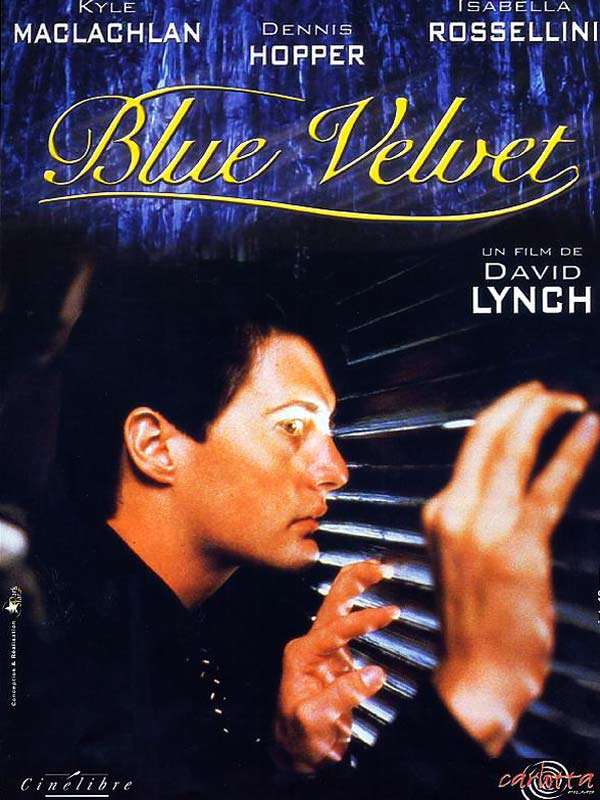
I have been watching movies at a furious pace for the last more than a year. I think on an average it will almost be two-three movies every week. Almost all of them, the so-called "art movies" -- classics and contemporary, narrative or experimental, all kinds, even bollywood (Gangster was good, that was the last one). In that clogged movie going calendar of last year two events stand out very well. They were the anniversary screenings and big screen revivals of Charlers Laughton's The Night of the Hunter and David Lynch's Blue Velvet, which are easily two of the best American movies ever made (my opinion of course).
The Blue Velvet revival has now reached LA and the newspapers and magazines are reprinting their original reviews, essays and interviews about the movie. The all knowing and hard working folks at the green cine daily have collected lots of links in one page here. Really worth reading them all.
This article in The Guardian asks the question, which films released in the last year can potentially enter the canon or be remembered and loved ten, twenty years from now. I think Michael Haneke, David Cronenberg and Wong Kar-wai all came out with great films last year and I loved them all. Even if the individual films do not stand the test of time, there is no doubt that their whole oeuvre will certainly do and if not for anything else, these films will be remembered for being associated with their respective auteurs.
Also, a few years back Guardian came out with a list of most important contemporary filmmakers based on the poll of their resident film critics. Except for a couple of names in the top ten, it is pretty well judged (my opinion of course and I haven't seen a few on the list at all). You can find out the list here.
In the same vein here is my own list of filmmakers who I like to keep track of (at this point in time) and impatiently look forward to their next works:
1. Michael Haneke: I have lost lots of my innocence, naivety and optimism (of whatever little that was left) because of watching his films, so far five of them. But I am all the more thankful to him because of that. With Cache, Haneke is now at the peak of his career. It is worth waiting for whatever he is upto next. I had written earlier on Funny Games, The Seventh Continent and Cache.
2. David Lynch: I am waiting desperately to see Inland Empire which should open later this year. This reminds me, I should try to get hold of Twin Peaks season 2 before I leave for India. Previous posts on Lynch here and here.
3. David Cronenberg: Another dark maestro. He is making a horror movie about a plastic surgeon next. It is already giving me shivers. The bad/good news is that no one is willing to finance his film after reading his script! An adaptation of Martin Amis's misanthropic and apocalyptic London Fields is also in the works. Whatever it is, if it is a film by Cronenberg, that means not to be missed at any cost. Previous post on A History of Violence.
4. Lars von Trier: I missed his latest Maderlay. One more reason why I should hate my life and my job and of course people too. It was in theatres here only for one week and before I could find time it just vanished.
5. Wong Kar-wai: The list was getting too dark, bleak and misanthropic. So here comes Wong Kar-wai with his les affaires de coeur. Although even his films are suffused with a deep sadness and speak less about the pleasures of romance than they do about the impossibility of genuine, lasting connection between human beings in the modern world, specially in the big, impersonal cities. But whatever, at least his films have glorious music and lots of beautiful people and at least there is no violence (not of the haneke, cronenberg variety at least). Previous post on 2046 here.
P.S. Now that I am praising Haneke. I wanted to point to this entry in the culture vulture blog of the guardian. Apparently Time Out London revised their movie rating system to accommodate Cache. They gave it six out of five and then revised the scale upwards to six on the grounds of perhaps inflation and devaluation! Too many good movies?
Something that is keeping me excited these days. Blue Velvet is getting revived in a new print and is coming to my place in a couple of weeks. Village Voice has a brief article by filmmaker Guy Maddin and New York Times pitches in too.
"Blue Velvet," which delighted many and repelled many others in 1986, is likely to evoke roughly the same mixture of reactions today, and 20 years from now, and on and on. There's no assimilating its dark-and-light vision, no explaining its real mysteries, and no handy term to categorize it: not "hip" (as might have been said back in the day), and certainly not "edgy" (as canny marketers have trained us to say since). Why are there movies like "Blue Velvet"? Because the world is strange, and the strangeness never goes away.
Although it is difficult, perhaps impossible, to summarise any of the three short films by Lynch that I saw today but I will try (and it is true for any surrealistic and abstract work of art, they exist precisely because conventional language fails to convey or even approximate what those works of art want to convey). Anyway, the first film The Alphabet, which is about five minutes long, starts with an animation with English alphabets appearing on screen in some random way and then the capital 'A' gives birth to small 'a' which then metamorphoses into a human figure. Not some regular human form but a surrealistic kind of human form direct out of those famous paintings which disfigure and distort human face and organs. Then all the alphabets enter the brain of the human figure and then there is some blood and a female voice tells us that 'remember we are dealing with a human form'. I wish I could say something profound like--'the film is about the mysteries of language and central role that it plays in human existence' but I will leave all that intellectual talk for now! Honestly it didn't make any sense to me :)
The second short, The Amputee, is more straight-forward and so least interesting of the all three. A young woman with both her legs amputated is writing a letter and reminiscing about some of her friends. A nurse comes and does her bandage and dresses her wounds but the girl doesn't pay any attention to it at all. She just goes on writing the letter. Again no idea what the short was about!
The third film, the longest, the most interesting and the most coherent (comparatively speaking) of the all three is The Grandmother. A lonely young boy, who is abused by his parents plants a seed in his bed from which his grandmother grows (!). Boy has some nice time with her grandmother after that she perhaps dies after whistling loudly(!). The boy implores his parents to help his grandmother but they don't listen and whisk him away. He then meets up his grandmother in the grave yard.
In a nutshell the shorts are harmless intellectual exercises but unless you are a Lynch completist or a passionate student of surrealism, it is better to remain content with Lynch's Eraserhead. It contains all his experimental and thematic concerns that are on display in these shorts.
A brief introduction to some of these films is on this excellent website.
David Lynch is without doubt the greatest film maker working in cinema today, closely followed by David Cronenberg and Lars von Trier. Okay, in case you start accusing me of western bias or worse, ignorance--Martin Scorsese (by the way, should we call him contemporary?), Abbas Kiarostami, Wong Kar-Wai and others in China, Japan and Korea are good too. But having said that, hardly anyone's work comes even close to what Lynch has achieved in his rather short career, specially given that he is working in the mainstream Hollywood system. There is hardly any contemporary filmmaker who can claim to have an adjective derived from his name. The word "Lynchian", in its signification of the convergence of bizarre depravity with the surface normalcy of the mundane, conveys meanings which can only be experienced and felt.
I was confirmed in my beliefs after watching Blue Velvet the other night after a gap of almost two years. I was quite surprised to find out how the film has lost none of its powers to shock and unnerve me. And this was when, this time, I was consciously and objectively trying to understand the technique of the film and knew very well that the film was symbolic, not to be taken literally (it might just be a defence mechanism). I knew that the film was an allegory about the pains of growing up, a rather Miltonic screed on the pitfalls of gaining knowledge and the shock that comes with the loss of childhood innocence when initiated into the dark and twisted world of adult sexuality. But even with knowing all this, the film does manage to affect at a visceral level, and that's what makes Lynch's style so unique and so one-of-a-kind.
The first reaction to the film generally is--ohh, I know Lynch is just a smart guy, but things are not as dark or depraved as he thinks they are--but then Lynch is hardly making a general statement about human nature or indulging in social criticism, although it is equally valid to read the film in both ways--as psycho-analysis of sexual pathologies and social satire on the phony normalcy of suburban American life. What this film actually does is that it forces even the most passive and lazy viewer to take the same journey of self-discovery, that the hero takes, into the deeper recesses of self and confronting the darkness that lies inside, buried under the fragile sanity of everyday routine life. Of course not everybody likes this idea but for those willing to stare down the darkness, Lynch's films are, "like our own nightmares, oddly informative". Whether onscreen or in the world outside, we can't defeat our demons without knowing who they are and that's what makes David Lynch not only the best but also the most important filmmakers working today.


