Showing posts with label michael haneke. Show all posts

Sunday, October 07, 2007

Joseph Roth's Rebellion & Michael Haneke's TV Films

I saw Michael Haneke's film adaptation of Joseph Roth's Rebellion yesterday. I thought I will write something about the book too but then came across this review by James Wood in the Guardian. It is quite good, so I will just link it here. (He has written a longer essay on Roth too which is collected in his book The Irresponsible Self, titled "The Empire of Joseph Roth." I found it too technical but it is also quite good.)

This novella is not as great as his masterpiece The Radetzky March but if you have read that book you will probably want to check this one too. His melancholia and the dark and extremely pessimistic view of human history and human affairs in general is really something you can't shake off easily. For him things like God, Death, Fate, Destiny are all synonymous (he uses capital letters for all). Everything is already hurtling fast on the path towards doom and destruction, even the inanimate things. In common with a lot of Central European literature of that period, there is also an apocalyptic sensibility at work in his books which sees the end of the habsburgh monarchy as the end of the world itself. It was actually the case, specially for the Central European Jews who were left homeless after the rise of ethnic nationalism in the wake of the collapse of the empire, leading to catastrophic consequences just a decade later.

Wood is all praise for his craft and the skill with which he uses language but personally I find it a little overwrought though I can understand why someone can feel excited after encountering a sentence like, "Night attached itself to day, and then melted in the grayly victorious morning," to describe the passage of time. What I love in his books is not the craft, which is quite conventional, specially so if you compare it with his illustrious compatriots and contemporaries (Kafka, Musil et.al.), but rather his worldview and his dark, apocalyptic sensibility that I talked of earlier.

Roth wrote this book early in his career and it is very interesting to see how his ideas about the empire changed from an attitude disrespectful and critical of empire to a pure sentimental elegy. The hero of the novel is a "believer," he believes in the essential justness of the state (and the world) which he sees as an agent of a merciful and just God on earth, even after losing a leg in the war. It is only after a series of personal misfortunes that he realizes his folly and comes to the side of "the heathens," the rebels, the criminals, even the Bolsheviks! In the end though this idea of political revolution itself is given a completely different spin because of his "leftist melancholy" (as Walter Benjamin called it in a different context for a different writer whose I don't remember now.) This idea of moral rebellion against God and connecting to the the authority of an unjust state is already there in Dostoevsky. He even named his chapter in The Brothers Karamazov "Rebellion." It is quite possible that Roth had read Dostoevsky. The final monologue spoken by the hero, hallucinating that he is in the court while actually he is in his final death-throes, feels quite similar to Ivan Karamazov's speech in Dostoevsky's, the same accusation of injustice, the same expression of revulsion towards all authority figures including God, the same "I believe in Your existence but I revile You." Also the way he writes about the byzantine and comically (and tragically) inefficient Habsburg bureaucracy, intent on crushing weak and innocent human beings, does indeed put him in the same league as Kafka and Musil both, who wrote about the same on a much larger scale. (The cover picture above is very suitably Kafkaesque.)

******

Michael Haneke's adaptation of the novella as expected invites all kinds of superlatives - both as a cinematic work on its own and also as an enlightening companion piece to the book. (In fact it received a big applause from a packed audience at the moma.) This is one of those cases where the book and the film adaptation complement each, enhancing appreciation of both. I had read about the Viennese Waltzes that the hero plays on his portable Organ machine in the book but only in the film I really heard how it actually sounded. Haneke of course uses the same theme in other scenes as well, again giving a unity which is not as perceptible in the book. The cast as is usual with Haneke is uniformly brilliant, there is not even a single false note anywhere. He also bookends the story with newsreel footage of the war and the Vienna of the twenties providing a historical context which you otherwise have to bring with yourself when reading the book. The screen palette itself is a kind of faded brown giving it a feel of found footage. Also like in his adaptation of The Castle he uses overhead narration to mimic the omniscient voice in the book. It may seem like an easy way but it is actually designed very carefully, to create just the right ironic and contrapuntal effect between the action onscreen and the narration. I recently saw Fassbinder's Effi Briest, an adaptation of the nineteenth century German novel of the same name by Theodor Fontane, which used the same technique of extensive narration. In this case even many of the dialogues were "acted out" by the narrator. In the beginning the film feels static but as you get into its rhythm it is extremely effective.

The other TV film of Haneke I saw yesterday was not as good. Fraulein with the subtitle "A German Melodrama" looked at best a sub-Fassbinder work. The same subject is treated much more forcefully and effectively in Fassbinder's well known The Marriage of Maria Braun. It also takes a critical look at the speedy revival and regeneration of post-war Germany and shows that moral and spiritual compromise, willful amnesia are just the side-effects of the essential will to live and pursuit of happiness. This film has some complicated cross cuttings between the scenes making it very non-linear so stylistically it can't be compared to Fassbinder but I don't think this way of telling story added anything worthwhile apart from making it very difficult to follow, specially in the beginning. These two tv films also clarified the mystery specially for those who were astonished by his shocking debut The Seventh Continent. He had been honing his craft since quite long before venturing full time into feature film making. He also has an extensive experience directing Austrian theatre which probably explains his facility with the actors. I want to see his Three Paths to the Lake too which is based on a short story by Ingeborg Bachmann. It is sometime in the coming weeks. I had linked to the moma schedule before. Another link (the same exhibition I think) with brief details about his films here.

Sunday, July 16, 2006

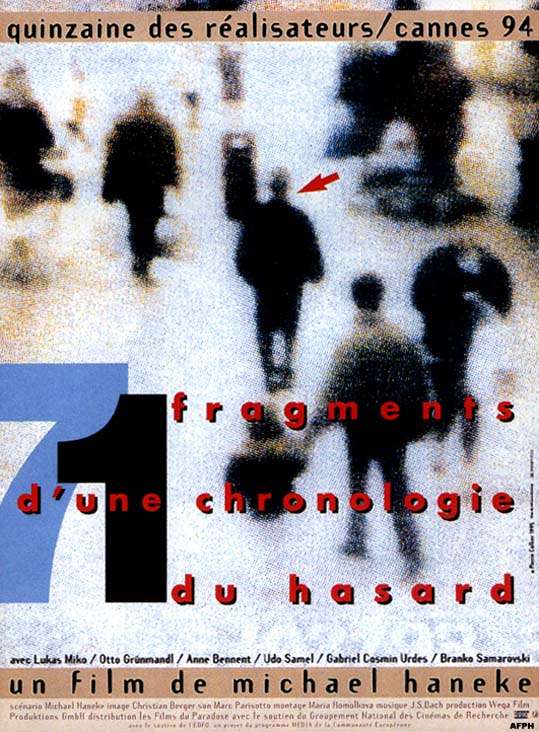
71 Fragments of a Chronology of Chance by Michael Haneke

71 Fragments starts by informing us that a young 19 year old student killed three people in a Viennese bank before shooting himself in the head. The film then shows, in exactly 71 disconnected shots (I didn't count), some random vignettes from the life of a bunch of characters and although the sequencing seems random, a narrative does emerge out of all this in the end, which manages to "explain" the freak incident.

Stylistically, it is a precursor to the similar but slightly superior Code Unknown that Haneke made in France. It is a similar tale of criss-crossing narrative, interstitial blackouts separating two scenes, scenes always ending in the middle of a dialogue etc etc. There are also lengthy and repeated media footage about the war in Sarajevo, Somalia and a curious news item about the trial of Michael Jackson on sex abuse charges. It rehearses his favourites theme about how media and TV contribute to social breakdown and individual alienation by providing us a false illusion of being connected with the reality and the world. There is a romanian refugee boy prowling the streets and living off the junk heaps. Then there is a couple who are having trouble with an exceptionally cold and distant girl who they are trying to adopt as a daughter. There is a long scene when a very needy old man just talks and talks to his daughter and grand-daughter on phone. The scene lasts for almost seven continuous minutes (yes I checked it) and it is extremely unnerving to see that old man so desperate to talk. There is another scene when a young man just keeps playing ping-pong with a mechanical ball thrower for what seems like eternity... The scene ends drastically although giving a feeling that he did feel unhinged and broke down after all. After all this the last shooting spree, although senseless and random, starts making sense in an abstract intellectual sort of way.

After the commercial and artistic success of Cache last year, Michael Haneke is at the peak of his career. May be that's the reason why the anthology film archives (full schedule here) in new york are showing a retrospective of his earlier films, which were never released in the US earlier. It is understandable why these films would have an extremely limited commercial appeal. More than the challenging and experimental narrative, it is the tone of these films, which is clinical, dry and forbiddingly intellectual, and the absence of humour, romance, happy endings or banal humanistic messages that will keep the casual audiences away. Their loss, that's what I say!

Short notices of the anthology retrospective from Village Voice, NYT and New York Sun. An essay on the film from the senses of cinema website here.

I had earlier written about Code Unknown, Cache, Funny Games and Seventh Continent. And a few days back about his movie adaptation of Kafka's The Castle.

Tuesday, July 11, 2006

The Castle: An Adaptation by Michael Haneke

Those familiar with the Austrian director Michael Haneke's oeuvre wouldn't be surprised to find an adaptation of Franz Kafka's The Castle in his filmography. Just like Kafka, his main concern in his movies is the alienation of man in modern society, though I think they both slightly differ from each other in their diagnosis of the problem. While for Kafka it was the unfathomable bureaucracy and the legal machinery of an all powerful state that led to the feelings of alienation, for Haneke it is the consumerist culture of late capitalist societies based on shallow individualism and self-gratification that is the source of the problem. This is not surprising given how the all powerful state and its attendant bureaucratic structures have withered away in the last few decades and how they have made way for equally, perhaps even more, impersonal and oppressive structures which have become part and parcel of advanced bourgeois and capitalist societies. In Haneke's movies all this is exacerbated with the collusion of the official culture industry - television, media and cinema - which fabricate false realities with false emotions for sale and profit and which in turn alienate people further from their real selves. The best of Haneke's films Code Unknown, The Seventh Continent and 71 Fragments of a Chronology of Chance illustrate this really brilliantly.

Now coming to The Castle, I was initially surprised to see the film. It is an extremely faithful and an exceedingly literal adaptation of Kafka's novel. There is even a voice-over which mimics the authorial voice of the novel at regular intervals, which gives it a sense of being an illustrative companion piece to the novel, which is what it actually is, rather than being an independent work. I am not sure if Haneke wanted it this way, but if at all he did, I think he succeeds very well. Other than the literal story there are other things he captures very well. One thing that intrigues me in Kafka, specially his novels, is the way he uses time and structures his narrative in such a way that we never get a sense of how much time has passed between two scenes. This is what gives his narrative a dream like quality. Just like in a dream the narrative exists outside the bounds of linear time. In fact, there has been a huge debate about the exact chronological ordering of the chapters of The Trial. A recent translation had the orderings altered based on some recently unearthed evidence about the way Kafka himself intended it to be (the book was put together from his manuscripts by his close friend Max Brod and was published posthumously). Anyway, I think Haneke achieves this effect rather well. Every scene in the movie ends with a jump cut to a blank screen, many in the middle of a dialogue and the next scene begins in what seems a rather abrupt manner. This discontinuity evokes the same feelings of reading Kafka's novels.

Also the background and staging of the scenes, though far from being surrealistic, approximate Kafka's description rather well. Haneke achieves it through wonderful use of lighting and framing. It is almost always dark in the movie, not the lights and shadow kind, but like a place where it is always twilight and it is always foggy. The camera never moves, mimicking the detached and neutral narrator of the novel. There are no long range shots of the village as a whole, and we just see houses half submerged in snow. There are no shots of the eponymous castle either, which is fitting no doubt. I think the only mention of the sight of Castle in the novel is in the very first sentence itself, which is itself an speculation because everything is covered with fog and it was already getting dark when K. first reached the village.

The acting, as always in Haneke movies, is uniformly brilliant. Specially Susanne Lothar in the role of Frieda, who was also magnificent in Funny Games. Her sex scenes with K. are just brilliant (just like in the book) and I think it was because of her acting that the role of Frieda becomes more important than what one gleans from a cursory reading of the novel. And because of this Haneke brings out the sexual subtext of the novel and the themes of sexual paranoia and fears of love and commitment, which are such an integral part of the novel, really very well. Also the two jokers, in the role of K.'s assistants, provide some good comic relief, perhaps the only comic moment in the entire Haneke's oeuvre (okay, there is a great funny joke in Cache too now that I remember!).

For those unfamiliar with Kafka's novels the film can actually be very frustrating. It is because the way Kafka structures his narrative which is diametrically opposite to conventional storytelling. The narrative never ever moves forward, every attempt to do so is thwarted by unseen and unexplained forces. The protagonist, and the reader, never achieves any better understanding of his condition in the end more than what he had in the beginning. And everything ends without any conclusion or explanation. The great thing about Kafka is how he subverts traditional story telling techniques and the exactness and precision of his prose which have a strange evocative effect on the reader and which enables him to address grave philosophical issues without ever getting into abstract or vague discussions himself. I think this is exactly what Haneke must have had in mind too. He also focusses on literal aspects of the novel and makes it evocative and suggestive of deeper and complex themes. Finally, I think this is a film which would be of interest mostly to Kafka enthusiasts or those who are taking a course in Kafka studies and need a reading aid to his novel! For others it will just remain a curious art house film.

This DVD Times review has more details and also has a few stills of K., his assistants and Frieda from the movie.

Saturday, June 03, 2006

And the Bravest Actress Award goes to...

...one of my favourites, Naomi Watts. According to news reports, she has been signed up for lead roles in Michael Haneke and David Cronenberg's next projects. Two filmmakers responsible for some of the most disturbing and violent films of recent times. Also two filmmakers who take themselves seriously and deservedly so. I was slightly disappointed to learn that Haneke is remaking his own German thriller Funny Games. I hope the new American version is different because I don't know if Funny Games can be improved in any sense. It is already as nasty as it can get. Cronenberg's next project, titles Eastern Promises, sounds equally dark. It is a story about illegal sex trafficking and prostitution in underground London. Viggo Mortensen is playing the other lead role. I hope Watts shines in both of the movies and so do the two directors. It was such a shame that Watts was ignored for her performance in David Lynch's Mulholland Dr.

Link to the news item.

Sunday, May 07, 2006

Michael Haneke's Code Unknown


Michael Haneke's Code Unknown: Incomplete Tales of Several Journeys is a profound look at the questions of communication (or the difficulty, perhaps even impossibility of), xenophobia, isolation and breakdown of community in modern, post-industrial societies. The concept is somewhat similar to the last year's hit Hollywood film Crash (it was released in the year 2000) but rest assured, it is not hard to guess why it didn't get anywhere near to winning any Oscars. It is a difficult film to watch, in not only the difficult questions it raises or its bleak dissection of contemporary society, but also because of the structure of the film itself. Like his other films Funny Games and Cache, Haneke makes sure that audiences know that they are watching a movie, that is, it is a representation of reality and not the reality itself. Each of the scenes is shot in one take, some long others short, and each ends abruptly, sometimes even before the dialogue ends, to a blank screen. There is absolutely no illusion of continuity, that we generally expect from a movie. Also the lead character, played with her usual brilliance by Juliette Binoche, is an actress who is acting in thriller film. There are a few scenes from the movie within the movie and Haneke shows in those scenes how easy it is to provide what audiences want -- thrills and chills. In the rest of the film he makes sure that audiences don't get any of these conventional satisfactions!

I won't attempt to write a comprehensive summary or review of the film. You can read some of them here. The sight and sound magazine also has a long summary of the film. I will just say that after watching it Crash would feel like a kiddie movie.

Just some stray thoughts. The film begins with a pantomime game being played by children. One girl makes a body/facial gesture and other kids guess what that gesture could be. Some of the guesses are, "Alone", "Sadness", "Imprisoned", "Hiding Place", "Bad Conscience". To each of these guesses the girl answers No but perhaps we the audience know better. It is all these emotions that the film that we are going to see will be about. This is a perfect introduction to the film.

Also the first regular scene of the film is a masterly long take (almost ten minutes) in which the camera tracks as the character played by Binoche talks to her brother in law. In it we see how a black man is victimised when he comes to avenge the insult to a woman beggar (who we later know is an illegal immigrant). As if to balance this scene (blacks are victims and white people are victimisers), we later see an arab youth gratuitously taunting Juliette Binoche about her race, class and gender. It is an extremely powerful and unnerving scene and I won't spoil it by describing it here. You just have to see it. Also the seen, with the collage of still photographs, first from the war scenes in Kosovo and then faces belonging to different race, culture and nationalities while the narrator recounts his experiences in Kosovo and Kabul, is quite eerie. I didn't know what to make of it. Reminded me of Godard's In Praise of Love.

Interestingly I was also reading Amartya Sen's collection of essays, The Argumentative Indian(which is brilliant by the way) this weekend. After watching Code Unknown, Sen's ideas and historical judgments looked hopelessly naive and optimistic to me. I know, I am being unfair to both Haneke and Amartya Sen when I say this. They are both looking at the same things from two different angles. While the situation in multicultural cities of Europe isn't something that we can be optimistic about, it can never be denied that we still have a long tradition of inter-community dialogue and communication and it is not impossible to continue the same tradition of heterodoxy and openness even in this age. I don't know, if it is naive to believe that human beings can transcend the barriers of class, race, nationality, religion, gender, age or just plain psychological fear, uncertainty, paranoia and anxiety and reach out to other human beings. Perhaps it is naive.

I had earlier written about Cache, Funny Games and Seventh Continent. (Yes, I am a big fan of Michael Haneke!)

A long essay on Haneke which discusses Code Unknown, Funny Games and The Piano Teacher.

Thursday, March 09, 2006

The Classics of Tomorrow?

This article in The Guardian asks the question, which films released in the last year can potentially enter the canon or be remembered and loved ten, twenty years from now. I think Michael Haneke, David Cronenberg and Wong Kar-wai all came out with great films last year and I loved them all. Even if the individual films do not stand the test of time, there is no doubt that their whole oeuvre will certainly do and if not for anything else, these films will be remembered for being associated with their respective auteurs.

Also, a few years back Guardian came out with a list of most important contemporary filmmakers based on the poll of their resident film critics. Except for a couple of names in the top ten, it is pretty well judged (my opinion of course and I haven't seen a few on the list at all). You can find out the list here.

In the same vein here is my own list of filmmakers who I like to keep track of (at this point in time) and impatiently look forward to their next works:

1. Michael Haneke: I have lost lots of my innocence, naivety and optimism (of whatever little that was left) because of watching his films, so far five of them. But I am all the more thankful to him because of that. With Cache, Haneke is now at the peak of his career. It is worth waiting for whatever he is upto next. I had written earlier on Funny Games, The Seventh Continent and Cache.

2. David Lynch: I am waiting desperately to see Inland Empire which should open later this year. This reminds me, I should try to get hold of Twin Peaks season 2 before I leave for India. Previous posts on Lynch here and here.

3. David Cronenberg:
Another dark maestro. He is making a horror movie about a plastic surgeon next. It is already giving me shivers. The bad/good news is that no one is willing to finance his film after reading his script! An adaptation of Martin Amis's misanthropic and apocalyptic London Fields is also in the works. Whatever it is, if it is a film by Cronenberg, that means not to be missed at any cost. Previous post on A History of Violence.

4. Lars von Trier:
I missed his latest Maderlay. One more reason why I should hate my life and my job and of course people too. It was in theatres here only for one week and before I could find time it just vanished.

5. Wong Kar-wai:
The list was getting too dark, bleak and misanthropic. So here comes Wong Kar-wai with his les affaires de coeur. Although even his films are suffused with a deep sadness and speak less about the pleasures of romance than they do about the impossibility of genuine, lasting connection between human beings in the modern world, specially in the big, impersonal cities. But whatever, at least his films have glorious music and lots of beautiful people and at least there is no violence (not of the haneke, cronenberg variety at least). Previous post on 2046 here.

P.S. Now that I am praising Haneke. I wanted to point to this entry in the culture vulture blog of the guardian. Apparently Time Out London revised their movie rating system to accommodate Cache. They gave it six out of five and then revised the scale upwards to six on the grounds of perhaps inflation and devaluation! Too many good movies?

Saturday, March 04, 2006

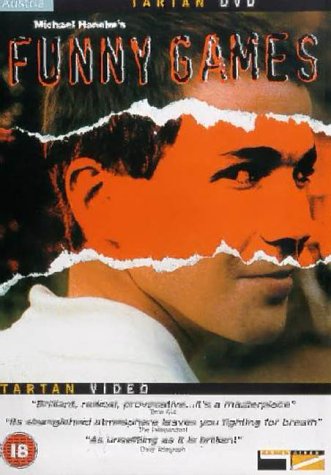
Michael Haneke's Funny Games


Michael Haneke's Funny Games is less of a horror-thriller than a meta-cinematic, post-modern distillation of the cliches and the conventions of the genre. It is more like a theoretical, critical essay on representation of violence in cinema. Sounds dull and dour? Well, it is not. It is also a brilliantly executed thriller in itself, expertly staged and handsomely acted, with a taut narrative and sharp dialogues, which keeps you on the edge for the entire length of the film, while at the same time consciously denying all the pleasures or thrills that are generally expected from a horror-thriller at every step of the way.

The plot is deceptively simple. A pair of smooth talking, young twenty-somethings break into a house of a bourgeois couple who are vacationing in their lakeside countryhouse and systematically start to torture them physically and emotionally. But as they say, the devil is in the details. When the husband asks the killers why they are doing this, one of them starts telling the story about how the other had a terrible childhood, committed incest and and became a queer and a psychopath and the other starts crying only to break into a laughter after the story ends. Thus mocking theirs and ours need for pyschological explanations that we expect from a thriller. Not that pyschological explanations for violent behavior don't exist but rather it enables the viewer to turn into a voyeur by making it easy for him to distance himself from the perpretator of the violence. I also thought the incest angle was perhaps a sly reference to Hitchcock's Psycho. The torturer also offers some other "explanations" and offers the couple and the viewers to choose one, best of which was "ennui, world-weariness and the terrible void of existence"! Somewhere else, Haneke shows a close-up of a knife thus adding a sense of foreboding in the audience that the knife will play a crucial role in the narrative but when it comes to that, it is completely offscreen. Also notable is the fact that although the film is infamous for being extremely violent, none of the violence occurs onscreen. We are even spared the close-ups. There is also a remarkable scene [SPOILER] in which the wife gets a chance to pick up a gun and shoots one of the guys. But then the other one takes a remote and "rewinds" to the scene and then takes the film to a different, more brutal ending. This is the most cruel mockery of our need for those thriller type "wow-moments" in a film that I have ever seen. I am sure after watching this scene your whole experience of watching a thriller would change forever.

In short, although definitely very heavy going and strictly for adult and mature sensibilities (the whole thing is a profoundly disturbing affair), this is a remarkable and rewarding viewing experience. Some reviews and links: Jim Hoberman in Village Voice calls Cronenberg's A History of Violence, "a successful version of Michael Haneke's audience-bashing Funny Games", with which I couldn't disagree more. If there was a element of self-critique and self-reflexivity in Violence I completely missed it. To me it was exactly the kind of violent film that it is supposed to deplore. The pleasures of the film are strictly conventional -- "good guys shoot bad guys in style after they are cornered and the audience claps". Other critics accuse Haneke of being self-righteous, preachy and manipulative but I think in doing so they forget that the film is not a realistic representational movie but more of an abstract, theoretical essay. The characters are types and tropes used by the filmmaker to drive home a point, something that any writer of a rhetorical essay does. Also there are other critics who say that Haneke, in his critique of conventional horror-thriller movies, is underestimating the audience's capabilities of differentiating between fiction and reality, which I think is a more complex question. Does fictional depiction of suffering make us more sympathetic (as Picasso claimed while justifying his painting of Guernica) or does it desensitise and makes us indifferent of the real pain and suffering? To which the answer definitely is: it depends. Depends on the motive of the artist and the audience. Surely the senseless consumption of empty thrills and chills that are the staple of hollywood have the potential to turn us into emotional zombies. And to which films like Funny Games are supposed to act as a corrective. Some critical and laudatory articles on the film are here, here and here.

Previous posts on The Seventh Continent and Cache.

Sunday, February 26, 2006

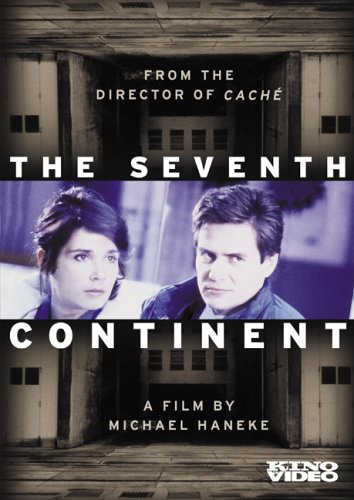
Some Thoughts on The Seventh Continent


Tolstoy's Anna Karenina starts with what is perhaps the most famous opening sentence in a novel ever. It says, "happy families are all alike but every unhappy family is unhappy in its own way" (which is perhaps true not just for families but for individuals too). This is also the reason I generally give when people ask me why I avoid films which show happy people enjoying life, you know, beautiful young people falling in love or nice families with cute kids having fun etc. The reason is simple -- they just bore me to death. Unhappy people are far more interesting in an artistic sense, in the sense they are more complex in their psychological motivations and relationships with other people. They also generally have more interesting and less-obvious things to say about life and the world we live in.

What set me thinking along these lines was two movies that I saw in the past few weeks which must possibly be the two of the most feel-bad and uncompromisingly bleak films I have ever seen. The first was Robert Bresson's Mouchette in which a young girl's suicide feels like God's grace and the other was Michael Haneke's The Seventh Continent in which an ordinary bourgeois family's existential isolation and anomie grows so acute that they decide to destroy all their material possessions and then collectively take their own lives, along with their kid daughter. It is without doubt a masterpiece and obviously rests up there with the key modernist texts of European cinema, masterpieces by Antonioni, Bresson or Resnais. Just like those classic films, Haneke elevates form to the level of content, so that his use of cinematic devices, for example what he decides to put in background and what in foreground, how he stations and moves his camera, itself becomes more important than either the story, character, dialogues or the environment that they depict and as result the film speaks far more eloquently on the subjects than a conventional narrative could ever hope for.

Some of the things that he uses are narrative ellipsis and focus on the background (like in L'avventura) or the use of disjunctive and contrapuntal narration (like in Hiroshima mon Amour) or his relentless capturing of daily activities of the characters using a static camera which mysteriously achieves a complex meaning (just like Bresson's Pickpocket or A Man Escaped). Haneke in fact makes an obvious homage to Antonioni's Red Desert in a scene where the kid daughter fakes blindness in school (ostensibly in order to attract attention). In Red Desert Monica Vitti's son fakes a disablity in walking. Also there are dreamlike intermittent scenes of a tranquil beach (the seventh continent of the title) which hark back to the similar scene in the earlier Antonioni film.

What I like best about Haneke's films is not only its clarity of vision but also the way he distances himself from the hipster school of filmmaking which fetishizes violence and exults in the death of feeling and artificiality of the cinematic enterprise. He actually believes that cinema is connected to reality and it is not just a play of siginifiers, a manipulation of symbols which represent nothing but other artificial symbols. In this way his films become far more effective than the infantile provocations of, say, Gaspar Noe's Irrerversible, not to say anything about the ridiculous Kill Bill movies or that korean movie Oldboy, some of the few films which have triggered debate about the portrayal of violence in cinema in recent times and which are also some of the films, which are praised for being artificial.

Haneke's vision of contemporary life (the western bourgeois life to be specific) might be uncompromisingly bleak but his vision is also slightly heartening in the sense that they convincingly show that cinema can still do what it is supposed to do -- force the viewer out of comfortable and shallow certainties and make them question their priorities in life, question the ways they see themselves, people around them and the world in general.

Okay, I didn't say anything about the film in question but you can read about it here and here.

This promotional page of the film calls it "a better class of horror film". I completely agree. Also has this quote from Chicago Tribune review:
"THE SEVENTH CONTINENT is a calm chronical of hell...how commonplace people can erupt into despair or violence...Beautifully controlled, liberatingly intelligent it establishes Haneke as one of the more remarkable young contemporary filmmakers. The climactic half hour of this film ranks among the most truly terrifying in the modern cinema."

Monday, January 16, 2006

Who Sent the Video Tapes?

As generally happens with mystery movies which are also "art movies" this question never gets answered in Cache, the latest film by the Austrian film director Michael Haneke. As viewers of his previous films know, there is hardly any other filmmaker currently working in world cinema who is more audience unfriendly. None of these facts will stop me in proclaiming that Cache is a masterpiece and perhaps the best film of the last year (I have still not seen many films of the last year, so this might be subject to revision).


The story is about an upper class intellectual couple living in Paris. Georges played by Daniel Auteiul is a host of some highbrow literary chat show on television (they discuss such esoteric literary subjects as the latest biography of Rimbaud's sister) and Anne, his wife, played by Juliette Binoche, works as an editor in a publishing firm. (Their apartment is full of books although it looks like that books are meant more for interior decoration than for reading.) They live a quiet, easygoing life until one day when they receive an anonymous video tape showing that they are under some kind of surveillance. More tapes follow, accompanied by childish drawings of faces squirting blood. Soon things start getting strange and difficult for the couple. They start bickering because Georges obviously is hiding something from his wife and is troubled and angry. A minor incident on street brings out the violent side of the supposedly civilised couple and finally, who is that boy with his face smeared in blood, whose image is flashed on the screen on more than one occasion? Is it Georges's dream?

Georges's investigation into the tapes leads him to his own past and to a rundown apartment which is now inhabited by an Algerian named Majid who is of the same age as Georges but looks so sad and heartbroken that the question of 'did he shoot the tapes?' doesn't arise at all. Not so for Georges who convinces himself that it is indeed Majid who is terrorizing his family and then goes on to threaten him. Majid, as it turns out, was betrayed by Georges in their childhood and this was when Majid's parents were killed in a protest by the French police (an actual historical event that happened). A couple of startlingly violent scenes follow which are sure the jolt anyone out of their seats and then the film ends with an extremely puzzling scene which made me dive right into the internet message boards as soon as I came out of the theatre.

I was initially suspecting a Lost Highway kind of resolution, thinking that it was indeed his own guilty conscience that was making Georges invent those tapes. In Lost Highway the guilty conscience gets personified into the spooky "mystery man" but Haneke, unlike David Lynch, leaves no room for metaphors or symbols to hide behind. It is all as naturalistic as it can be done. Shot on digital video, without camera movement and in long takes, the video or indeed the whole film, appears so detached, clinical and objective that it could only be the God's eye that is watching all of them. Okay, there goes my theory and I haven't stolen it from anywhere :)

Whoever sent the video tapes, the film remains a feast for the intellect, something that will challenge and provoke even the most laid back viewers to think about things that they wouldn't otherwise bother to think about. Haneke's two earlier films, The Piano Teacher and The Time of the Wolf, while undeniably brilliant, were very abstracted and almost theoretical works. Cache isn't like that. It is great psychology and great politics mixed with a genuine concern for the real world. A must, must see!

P.S. Don't leave the theatres before the end credits and don't forget to check out what is happening on the left bottom corner of the screen. This is if you are interested in contributing to the discussion on the message boards!

Sunday, November 27, 2005

Michael Haneke's Cache (Hidden)

One film I have been eagerly waiting to see is Michael Haneke's Cache. It was shown in competition in this year's Cannes film festival, where it won the best director prize for Haneke and along with Cronenberg's A History of Violence(which I saw last month and which is a great film, although slightly disappointing and "mainstream" by Cronenberg's standards), was surely the most talked about film there. Haneke is the current bash-the-bourgeois film maker of Europe, a mantle he seems to have inherited from the likes of Bunuel, only that his mood is very Teutonic, always glum and totally humourless (very unlike Bunuel). Actually, Haneke has said publicly somewhere that he would never ever make a comedy!

Anyway, Film Comment has a long article on his latest film. It disses one of my favourite contemporary film maker on its way to lionize Haneke (Lars von Trier makes "political cartoons"!). Nevertheless, it is a good summary of his career so far and tries to place his latest film in the context of recent political developments in the west.

Since his first theatrical feature in 1989, The Seventh Continent, German-born Michael Haneke has dispensed post-9/11 visions of violent, benumbed swatches of middle-class society on the brink of dissolution. Four years and numerous debacles after the onset of our apocalyptic era, it is increasingly clear that in our heads—as, for the most part, comfortable, educated, anxious urbanites who also constitute the prime audience for Euro art cinema —we inhabit the same unremittingly bleak, paranoid landscape within which Haneke conducts his nasty business. It is a place we would call home only under duress. Hidden (Cache), his latest and arguably most accomplished provocation, revolves around central characters and a plot predicament that —despite being set in an unnamed French city —feels terrifyingly familiar. That's the operative word, terrifying.

The whole article here.
A good account of Haneke's career and his past films can be found here. Senses of Cinema profile here.

Saturday, October 08, 2005

"The Discreet Masochism of the Bourgeoisie"

I often find myself in situations during discussions over films or books where I proclaim the film to be "feel-good" and that's where the discussion ends. It is, as if the film is feel-good, I don't bother myself too much thinking about it. It is ipso-facto sentimental, dishonest, manipulative or worse, it flatters the bourgeois illusions of the viewers. This doesn't happen always but it does happen sometimes. On the other hand if the film is "feel-bad", it often gets called "subversive", "moral" , "serious", "intelligent", in short, a work of art. Early this year I saw two such films and had a hard time defending them. One was Lars von Trier's Dogville, which plumbs new depths (okay, make it heights) of cynicism about human nature and the other Michael Haneke's Piano Teacher, which made me shudder with fear with its stark and utterly clinical portrayal of human disconnection. Although I loved both the films, Haneke's more than the other, I had a hard time defending these, specially with friends who call films like Forrest Gump a work of art. (Me? I find it feel-good and so, manipulative, sentimental and dishonest !)

That's why I found this short essay by A.O. Scott of the New York Times very interesting. Discussing the latest films by the two of the most feel-bad filmakers of contemporary times, he says:

The sting of movies like "Manderlay" and "Caché" can have a salutary effect, since the discomfort they provoke, even when it takes the form of defensive anger, is an antidote to the soothing reassurance that we find elsewhere. But the masochistic embrace of art that tries to hit us where we live can provide its own perverse form of comfort. Feeling bad about ourselves can become a way of affirming our own goodness, a sign of moral virtue and political concern that costs nothing more than the price of a ticket.


Which is quite true. These feel-bad movies, quite paradoxically, make us feel good about our intellectual and moral capabilities, not by doing anything but just by the act of having seen and understood those films. This is not to say anything against Michael Haneke or Lars von Trier. They are artists in the true sense of the word and of course, not just because their films are feel-bad. More on their films later. I am feeling too bad right now!

By the way, Scott says, "Mr. von Trier's cynical view of human nature can make Mr. Haneke look like Frank Capra,". Hmmm. Now, I am not too sure about that.