Showing posts with label isabelle huppert. Show all posts

Friday, August 08, 2008

Isabelle Huppert


Actors who are able to play a wide variety of roles are generally considered more skillful than those who play a similar type of roles, however brilliantly. This is, I concede, not without justification and that's why I think Meryl Streep is a much more skillful actor than Isabelle Huppert. She can be an over-the-top villainous boss in one film (The Devil Wears Prada) and right in the next film can break your heart singing a sentimental ditty about her late "mama" (A Prairie Home Companion). In contrast Huppert through her choice of roles (and more than that her choice of directors) has confined herself to a very specific character type: frosty, distant, irritable, edgy, contemptuous and full of inarticulable pain and despair (just to list a few). As she says in this interview, "But if I do have a stereotype, I am my own stereotype. It's nice to change but you cannot totally give up who you are, even if you have a big temptation to do so." Even when she is doing a different role, like in Francois Ozon's comic farce 8 Women, she is actually in fact doing a self-parody. It won't make sense or be funny to those who are not aware of the "Isabelle Huppert" persona.

In her interviews she is very forthright and clear about her conception of cinema, which is hardline auteurist. She believes that cinema is the expression of director's personality and subjectivity and an actor is just a tool which enables him to realize his vision on screen. She won't agree with it but I think if one takes a look at her body of work she herself comes across as some kind of an auteur, maybe an auteur by proxy because she chooses directors who are close to her own personality. Even her external appearance seems to be remarkably consistent. She does change a few minor things (like hair for example) but she mostly remains the same, most remarkably her pale and ridiculously freckled skin (I can't imagine any other actor who has more freckles on her skin than her). She never hides it under makeup and in fact directors often highlight this aspect of her appearance. As her proud husband in Patrice Chereau's Gabrielle says, "Paleness is one of her attractions."

I think the most important thing that distinguishes her from most other actors, specially female actors, is her absolute refusal to exteriorize emotion and inner feelings. Instead she just gives hints about it through her face, body posture and her voice. It is upto the audience then to think and find out what is going on behind that cold, distant face of hers and it is this which results in a level of engagement deeper than what most actors are able to achieve. It also helps since most of the characters that she plays suffer because of their inability to articulate their inner thoughts and feelings. It is often claimed by feminists that patriarchal cinema aestheticizes female suffering and turns it into a spectacle, in the process objectifying it. (I agree with the aestheticization bit, but I don't believe it necessary objectifies suffering.) She seems to be very conscious of this line of thinking and as a result the suffering female characters that she plays are far from aestheticized. She makes it impossible to feel pity for her characters, that most disposable and easiest of all emotions. Instead she gets deeper into the subconscious of the viewer bypassing the simple emotional identification that most actors aim for. She also avoids the cliched psychologizing that many actors and directors use to create character.

I have seen quite a few of her interviews and indeed it comes as a shock to see her as easygoing and jovial. Though if one looks closely the distance and the feeling of "I'm not really here" is almost always there. In her interviews she also says that she doesn't have any conscious "technique" that she uses. She also says that she never does any kind of research into her roles and the text and the director are the only sources of external information she has and on which she bases her interpretation of the role. The interview was actually in the context of her performance in the play 4:48 Psychosis written by British playwright Sarah Kane. Soon after writing it Kane committed suicide (she was 28). I haven't seen or read the play but it is actually written like a suicide note and performed as a one and half-hour monologue by an actor who has to keep standing at the center of the stage grounded like a tree. Huppert received lot of critical acclaim for performing in this role but when the interviewer asked her if she did any research on why Kane committed suicide and any other reading on suicide she denied doing any of these things. For her it is just the immersion in the text coupled with her imagination that enabled her to get close to something as extreme as the subjectivity of the author in 4:48 Psychosis. I personally find it hard to believe that one can intuitively immerse one's self in such extreme situations but then I really find acting one of the most mysterious of all artistic activities. (Admittedly acting isn't always artistic but with her it is definitely an exception.)

One can really go on and on writing and talking about her. Her oeuvre is simply one of richest of all contemporary actors and provides food for endless intellectual and emotional stimulation. I personally have had quite a few nightmares about her after watching her films, something I can't say about any other actor. I find her very unsettling and very disturbing - almost as if she knows some dark and really terrible truth and is hiding it behind her pale face.

Below is my own top 10 favourite of her films (from the ones I have seen so far):

The Piano Teacher (Michael Haneke, 2001): She plays an aging and repressed piano teacher who refuses to succumb to the seduction of a young admirer leading to extremely painful consequences. A very disturbing and depressing film, also a masterpiece.

Women's Affairs (Claude Chabrol, 1988): She plays an amateur abortionist in the Nazi occupied France with such chilliness that it sends shivers down your spine.

The Lacemaker (Claude Goretta, 1977): She was never more beautiful than in this film. She plays a young girl hopelessly in love but unable to articulate which is then mistaken for her dullness. Another painful and haunting portrait.

The Ceremony (Claude Chabrol, 1995): For a change she plays a flamboyant character, that of a psychopathic postoffice clerk who conspires to kill a bourgeois family with a murderous maid (played brilliantly by Sandrine Bonnaire in a Huppert-esque role)

Violette (Claude Chabrol, 1978): Based on a real story, she again plays an inarticulate teenager who plots to murder her parents to get money for her lover.

Loulou (Maurice Pialat, 1980): She plays a bourgeois wife who leaves her husband for a loutish man (played by Gerard Depardieu). She is again very beautiful in this film.

Madame Bovary (Claude Chabrol, 1988): Not really successful as a faithful adaptation, ironically because of Huppert's presence. Her Emma Bovary is much too deeper and complicated than the one in Flaubert's book.

Merci Pour le Chocolat (Claude Chabrol, 1999): If the sweetness of Hollywood Chocolat (with Juliette Binoche) had you puking this might be an antidote. Huppert has her own chocolate recipe which includes a dose of poison.

Gabrielle (Patrice Chereau, 2005): "Paleness is one of her attractions." A proud husband's life is shattered when one day her wife decides to leave him and then comes back.

8 Women/I heart huckabees (Francois Ozon/David O. Russell): As my one line summary might have indicated, these are not really what you would consider a "healthy" watching. So for a change these two light-hearted self-parodies.

The catalogue of the museum of modern art has more details about these and her other films. I want to see Malina which is based on the novel by Ingeborg Bachmann.

Some other interviews: from the guardian at the london film festival. A profile from Sight and Sound.

Saturday, July 26, 2008

Susan Sontag on Isabelle Huppert

Nothing special really. It is actually adapated from an address she gave at a function to celebrate Huppert's work (more details at the bottom). It was short so I thought let's copy it here, since it doesn't seem to be available on the internet. It is taken from the book Isabelle Huppert: Woman of Many Faces which I had briefly mentioned before.

******

I grew up in the American provinces, in the American Southwest. And when I was a child, thinking of growing up and where I wanted to live, I couldn't decide whether I wanted to live in New York or Paris. Those were the two ideas of paradise for me. I luckily got to do both for large periods of my life. I do live in New York, but I certainly consider Paris my second city. I have spent a huge amount of my adult life there, and it's been my pleasure to think of France and French culture and, perhaps more actively than any other part of French culture, French cinema as central to my life...

Isabelle Huppert ... is an actor of unlimited ability, with what looks like already a very long career, a career I consider to be, at most, at midpoint - a body of work and a talent from which we can expect anything in the future, anything and everything.

I would like to mention five attributes of this great actor that make her such a formidable and exemplary presence. I mention them in no particular order, although the very fact that I must give them in a certain order perhaps betrays a certain partly indefensible personal bias. So I will list these five characteristics that I think make for a kind of total artist, a total artist in the most admirable sense.

The first quality that I would mention is beauty. That's not usually the first thing that one mentions, but I think I have an ancient Greek rather than a Christian view of beauty. I think beauty is a virtue - that's a pagan view, not a Christian view, but for me beauty is a virtue. And this is a person who exemplifies and extraordinary physical beauty, something that matters to us a lot in actors, and a lot more than sometimes we are willing to acknowledge consciously.

Then of course, number two: There's something called talent, and what is talent? Talent is above all, expressiveness, eloquence, the capacity for expressiveness.

Third - I say this is in no particular order and yet I can't, as I say, help feeling that some sort of perverse order in involved in the fact that I list them in the way that I do. After beauty, talent or expressiveness, the third I would call intelligence. Intelligence is not a quality that one thinks is necessarily present in a creative constellation. In fact it's very often said you don't have to be intelligent to be a great artist or a great actor. I think great actors are extremely intelligent and I have never met a more intelligent actor, a more intelligent person who is an actor, than Isabelle Huppert.

Fourth: I would mention her fearlessness as an artist, as an actor. And by fearlessness I also mean something very strong. I mean something that contains a large element of ferocity, avidity, appetite, availability, risk taking - a tremendous amount of risk taking.

And last, what may seem to be the opposite pole of the first virtue I mentioned, beauty: her integrity. Her integrity as an artist and - this I can testify as someone who knows her as a friend - her integrity as a human being. So it is an honour and pleasure to have the occasion to express my love and affection, admiration, for this great artist, for this great actor.

Adapted from a presentation at the French Institute/Alliance Francaise's Trophee des Arts Gala honouring Isabelle Huppert, New York, November 5, 2003.

Saturday, August 11, 2007

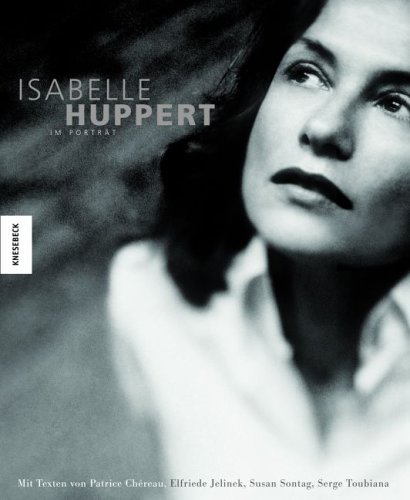
Isabelle Huppert: Woman of Many Faces


A few words about the picture-book Isabelle Huppert: Woman of Many Faces a cheap copy of which I came across and promptly bought last week. I had once been to exhibition which I think featured the same photographs a couple of years back and saw a couple of movies too at the film festival dedicated to her work. The book in addition to the photographs also collects essays and short appreciations by Elfriede Jelinek, Susan Sontag, Patrice Chereau, the French film director and Serge Toubiana, film scholar and the editor of Cahiers du Cinema. The essays are very brief but quite insightful at places. All of them repeatedly insist on one quality of the photographs: the "absence" of the subject. How she is there in the photographs and yet she is not there and how the photographers face up to this challenge. Toubiana says:

Her energy and strength are sometimes concealed behind a sort of melancholy, opacity, or neutrality--an absence, or a dream of being elsewhere. It is this crack that the greatest photographers have been able to capture, with her complicity. When she comes to let herself go in front of the lens, it is in fact she who is taking control, she who is watching us. [....] To be present in order not to be: That is what this actress seems to be telling us, by constantly playing with appearance and its mechanical repetition.

Susan Sontag lists five qualities that she likes in her: beauty, which she clarifies that she means the Greek beauty rather than the Christian (didn't really understand what she means here, I thought the Christians stole the idea from the Greeks) and also talent for expressive and eloquence, intelligence, fearlessness and integrity, which is again linked to Beauty.

The photographs are great of course. A common theme is indeed what the commentators identify -- absence. This is actually a paradoxical trait in an actress, the ability to hide and also to show, to be frighteningly intense and yet icily detached at the same time. It also works on screen because she chooses roles where she can exploit this same paradox. (It is most obviously in The Piano Teacher.) This is also the reason why the Madame Bovary character played by her becomes a different character than the one in the book. (And to me a more interesting one too. I am not saying anything about the overall adaptation in general.)

Most of her photographs also prominently highlight the frail figure and specially the pale and freckled skin that is her trademark. Sometimes the makeup hides it but it generally remains as it is. It is perhaps again the "absence" factor which de-eroticises most of her photographs, even the ones in which she is without clothes. (There are only a couple.) It is as if she were challenging and then defeating the voyeuristic intrusion of the camera. Overall a very fine collection. Recommended viewing for her fans.

This is a nice profile from village voice and more overview of her work from sight and sound.

Thursday, November 16, 2006

Isabelle Huppert Interview

A delightful profile and interview of Isabelle Huppert, "the queen of arthouse psychosis," as the guardian calls her.

I hadn't read this guardian review of Piano Teacher before...

At the premiere of Michael Haneke's last film but one, Funny Games - that intensely bewildering orgy of off-camera violence - audiences started staggering out after about 20 minutes, offended, revolted or maybe just winded. At the Cannes unveiling of The Piano Teacher this year, I like to think the critical community crossed the finishing line in better shape. We were just numbly silent, twitchily uncertain of when to speak. Only one person was in tears. I was reasonably calm but I think I remember leaving the auditorium on my hands and knees.

I think he is exaggerating but I remember being shaken and drained too by both the movies, but I really loved them both... And I think Code Unknown, that Haneke made in between, is even better than these two.

Friday, October 13, 2006

Isabelle Huppert


Anurag writes about my favourite movie actress Isabelle Huppert.

I recently saw this book at a bookstore. It's a collection of her photographs taken by some world-famous photographers. These are some of the most beautiful and haunting portraits I have seen. From the description on Amazon:

This most mysterious of actresses likes to be photographed but she is not an easy subject. She offers herself to the eye of the camera yet remains secretive, almost absent. The great photographers of our time—Richard Avedon, Edouard Boubat, Guy Bourdin, Henri Cartier-Bresson, Elliot Erwitt, Lartigues, Annie Leibovitz, Steven Meisel, Helmut Newton, Sylvia Plachy, Marc Riboud, and Scavullo—took up the challenge. Huppert’s energy and strength are often shrouded behind a kind of melancholy, and these photographers have captured beautifully that contradictory quality. Not only a collection of gorgeous images, this haunting book also unveils the bond between the public image and the secret soul of this unique woman.

The book also contains essays by the late Susan Sontag (the book contains photographs by her friend and partner Annie Leibowitz too), Nobel laureate Elifriede Jelinek and Serge Toubina, who is the director of Paris Cinematheque and former editor-in-chief of cahiers du cinema.

Here is a small photo gallery. Thank You, Anurag.

Thursday, July 07, 2005

Three Cheers for Isabelle Huppert


Isabelle Huppert is one of the best actresses (okay, actors if you insist) working in cinema today and certainly my favourite. She is famous for playing some of the most scandalous and transgressive roles in recent cinema. She has played among other roles, "sluts, nutters, illiterate murderesses, abortionists, psychopathic matrons, brothel madams, petit-bourgeois housewives purring with resentment and unslaked sexual thirsts." In her latest film Ma Mere, she shares some queasily erotic scenes with her on-screen son. The New York Times says:

The great French actress Isabelle Huppert, whose fondness for the transgressive has led her to star in movies like "The Piano Teacher" and "The School of Flesh," has finally shot the moon with this one.


I have seen only three of her films so far. In Claude Chabrol's Story of Women she plays an abortionist with such clinical and cold-hearted brilliance that it made even a radical pro-choicer like me flinch for a while. And her acting in The Piano Teacher left me profoundly disturbed. I was depressed and had lurid nightmares about blood and blades (if you don't know, don't ask) for two full weeks after watching that film. Her role in the recent I Heart Huckabees came as a welcome relief. What can be better than seeing Isabelle Huppert peddling the theory of "cruelty, manipulation and meaninglessness" and offering void and nihilistic disconnectedness as an antidote to the cloying Buddhist philosophy of Dustin Hoffman! Everything matters and everything is connected? Not for her. And so not for me!

Here is a delightful short profile of her. She is supposed to have said sometime: "Acting is a way of living out one's insanity." Check out her films to know what she meant when she said that.