Showing posts with label sebald. Show all posts

Monday, February 12, 2007

The Rings of Saturn Art Exhibition

The Guardian Review has details about an art exhibition inspired by W G Sebald's The Rings of Saturn, which is a (highly idiosyncratic) account of his travels through the coastal regions of East Anglia:

Before he stopped in Middleton, Sebald's fictional self went to Dunwich, one of the most important towns in medieval England, with possibly as many as 18 churches, before it was lost to sea. It was also a place of pilgrimage, in the Victorian age, for melancholy poets such as Swinburne, who described it as "a land that is lonelier than ruin". In Guy Moreton's photographs of the ruins of St Andrew's, Walberswick, captured with a 10inx8in camera, we get a sense of that dissolution. Lonely, yes, but the images are so dense, rich and sensual we nearly forget that they are recording the continual process of decay.

Moreton reminds us that faith erected these places, places that were once inhabited, active, hopeful. They are symbols of eternal life crumbling into dust and ash. By portraying them in quiet dignity, he gives us an assurance of their still-sacred value. The photos are accompanied by Alec Finlay's watercolours, reinforcing that spiritual symbolism. Finlay has transformed bell-methods, usually represented by number sequences, into rows of concentric primary-coloured circles.

More on the exhibition here.

Saturday, January 20, 2007

After Nature: W G Sebald

After Nature collects three long (each around thirty-forty pages) narrative poems by W G Sebald. It was his first book to be published in German apart from his literary criticism and essays. The English translation came only after his tragic death though postscript informs that the translation was approved by him before his death. Michael Hamburger, a published poet and literary critic who has translated Holderlin and Celan, did the translation. Hamburger was actually a close friend of Sebald and he makes a guest appearance as himself in The Rings of Saturn too. The translation here, as it is with other Sebald's books, reads extremely fluently.

The three poems are written in free verse, in fact it feels like reading his prose work itself. Just the lineation makes the experience of reading a little different by disturbing the natural flow of a sentence. But still it is easy to see that it was written by same Sebald who wrote The Emigrants or The Rings of Saturn. In fact it is not just in prose style but also in content that it is similar to his prose works. Two out of three are fact ridden biographical portraits of remote and mostly forgotten figures and third is an autobiographical narrative which recounts some of his childhood experiences and of his experiences of living in Manchester, again something that he later wrote about in Vertigo and The Emigrants.

The two figures that Sebald writes about are, the medieval German painter Matthias Grunewald, whose grief laden life was the inspiration for most of his paintings that depicted suffering in religious terms, specially the crucifixion and the eighteenth century German botanist George Steller who went on a disastrous sea voyage from Russia to Alaska. They are both real historical figures and Sebald's scholarship in both the poems sounds scrupulous. But ultimately it is not the facts which count in the poem, it is the emphasis that Sebald gives on selective facts, as if everything was filtered through his own melancholic worldview, to describe how "natural" the process of death, destruction and dissolution is.

This is how an ecplise is seen by the painter and it is not difficult to see how Sebald projects his own interpretation on the events as perceived by the painter.


On the first of October the moon's shadow
slid over Eastern Europe from Mecklenburg
over Bohemia and the Lausitz to southern Poland,
and Grünewald, who repeatedly was in touch
with the Aschaffenburg Court Astrologer Johann Indagine,
will have travelled to see this event of the century,
awaited with great terror, the eclipse of the sun,
so will have become a witness to
the secret sickening away of the world,
in which a phantasmal encroachment of dusk
in the midst of daytime like a fainting fit
poured through the vault of the sky,
while over the banks of mist and the cold
heavy bLuís of the clouds
a fiery red arose, and colours
such as his eyes had not known
radiantly wandered about, never again to be
driven out of the painter's memory.
These colours unfold as the reverse of
the spectrum in a different consistency
of the air, whose deoxygenated void
in the gasping breath of the figures
on the central Isenheim panel is enough
to portend our death by asphyxiation; after which
comes the mountain landscape of weeping
in which Grünewald with a pathetic gaze
into the future has prefigured
a planet utterly strange, chalk-coloured
behind the blackish-blue river.


and then:
Here in an evil state of erosion
and desolation the heritage of ruining
of life that in the end will consume
even the stones has been depicted.


from the Steller poem, describing how he died:
At Tyumen they carry him out of the sledge,
drag his half-petrified body
out of the ice into the fire,
into a furnace house.
Now begins alchimia,
Steller recognises the mortem improvisam,
the stroke and all its appendage,
sees his death, how it is mirrored
in the field-surgeon's monocle.
Such are you, doctores,
split lamps,
thus nature has her way
with a godless
Lutheran from Germany.

After Nature is a great companion piece to his great prose works and in a way an introduction too. Those looking for Poetry with a capital 'P' might be disappointed with all the facts and the history and the prosaic-ness in the poems but then it can also, and perhaps should be, read as something written in an experimental prose style.

Two reviews from The New York Times and The New Republic. It seems that people Sebald talks of are not that forgotten after all, wikipedia remembers them too. The entries on Matthias Grunewald, George Steller and Vitus Bering, on whose sea voyage Steller went.

Tuesday, November 07, 2006

A Mind in Mourning

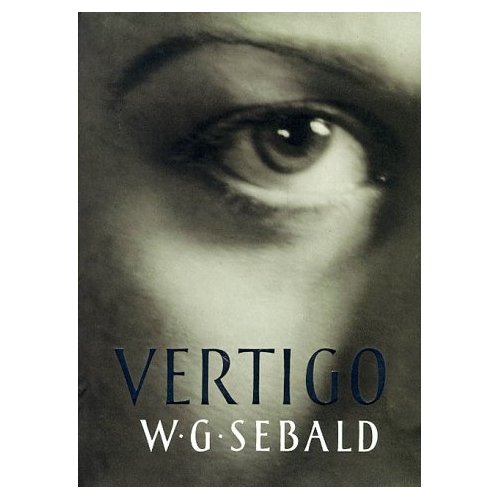
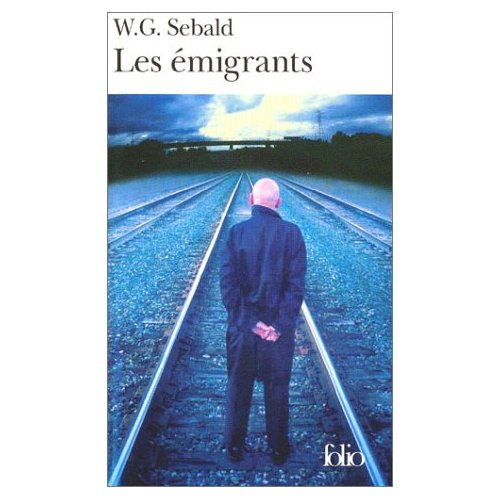
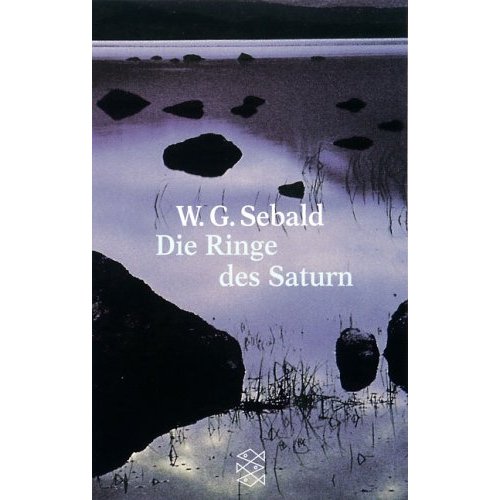
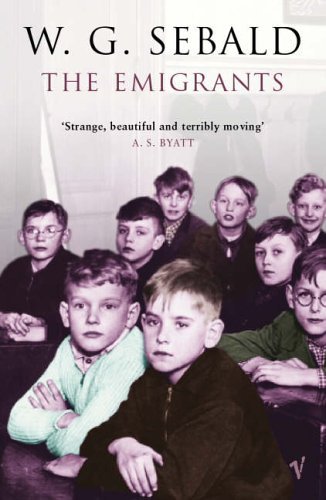
This essay by Susan Sontag is perhaps the best introduction to W.G. Sebald that I have read. It first appeared in Times Literary Supplement in 2000 and contains the appreciation of three of his books which were published at that time. This is not available on the internet. With this and the Ozick essay already here, now the excellent James Wood's essay on The Rings of Saturn remains. Will put that up here too. I have added some nice covers from English, French and German editions of his works. Formatting is slightly messed up, will try to change it later. Also the names in the original essay are in italics and there might be other minor errors. Will correct that later too.

~~~~~~~~~~~~~~~~~~~~~~~~~~~~~~~~~~

A Mind in Mourning


Is literary greatness still possible? Given the implacable devolution of literary ambition, and the concurrent ascendancy of the tepid, the glib, and the senselessly cruel as normative fictional subjects, what would a noble literary enterprise look like now? One of the few answers available to English-language readers is the work of W. G. Sebald.


Vertigo, the third of Sebald's books to be translated into English, is how he began. It appeared in German in 1990, when its author was forty-six; three years later came The Emigrants; and two years after that The Rings of Saturn. When The Emigrants appeared in English in 1996, the acclaim bordered on awe. Here was a masterly writer, mature, autumnal even, in his persona and themes, who had delivered a book as exotic as it was irrefutable. The language was a wonder--delicate, dense, steeped in thinghood; but there were ample precedents of that in English. What seemed foreign as well as most persuasive was the preternatural authority of Sebald's voice: its gravity, its sinuosity, its precision, its freedom from all-undermining or undignified self-consciousness or irony.

In W. G. Sebald's books, a narrator who, as we are reminded occasionally, bears the name W. G. Sebald, travels about registering evidence of the mortality of nature, recoiling from the ravages of modernity, musing over the secrets of obscure lives. On some mission of investigation, triggered by a memory, or news from a world irretrievably lost, he remembers, evokes, hallucinates, grieves.


Is the narrator Sebald? Or a fictional character to whom the author has lent his name, and selected elements of his biography? Born in 1944, in a village in Germany he calls "W." in his books (and the dust jacket identifies for us as Wertach im Allgau), settled in England in his early twenties, and a career academic currently teaching modern German literature at the University of East Anglia, the author includes a scattering of allusions to these bare facts and a few others, as well as, among other self-referring documents reproduced in his books, a grainy picture of himself posed in front of a massive Lebanese cedar in The Rings of Saturn and the photo on his new passport in Vertigo.

And yet these books ask, rightly, to be considered fiction. Fiction they are, not least because there is good reason to believe that much is invented or altered, just as, surely, some of what he relates surely did happen--names, places, dates, and all. Fiction and factuality are, of course, not opposed. one of the founding claims for the novel in English is that it is a true history. What makes a work fiction is not that the story is untrue--it may well be true, in part or in whole--but its use, or extension, of a variety of devices (including false and forged documents) which produce what literary theorists call "the effects of the real." Sebald's fictions--and their accompanying visual illustration--carry the effect of the real to a plangent extreme.


This "real" narrator is an exemplary fictional construction: the promeneur solitaire of many generations of romantic literature. A solitary, even when a companion is mentioned (the Clara of the opening paragraphs of The Emigrants), the narrator is ready to undertake journeys at whim, to follow some flare-up of curiosity about a life that has just ended (as, in The Emigrants, in the story of Paul, a beloved primary school teacher, which brings the narrator back for the first time to "the new Germany," and of his Uncle Adelberth, which brings the narrator to America). Another motive for traveling is proposed in Vertigo and The Rings of Saturn, where it is clearer that the narrator is also a writer, with a writer's restlessness and writer's taste for isolation. Often the narrator begins to travel in the wake of some crisis. And usually the journey is a quest, even if the nature of that quest is not immediately apparent.

Here is the beginning of the second of the four narratives of Vertigo:

In October 1980 I traveled from England, where I had then been living for nearly twenty-five years in a country whihc was almost always under grey skies, to Vienna, hoping that a change of place would help me get over a particularly difficult period in my life. In Vienna, however, I found that the days proved inordinately long, now they were not taken up by my customary routine of writing and gardening tasks, and I literally didn't know where to turn. Every morning I would set out and walk without aim or purpose through the streets of the inner city.


This long section, entitled "All' estero" (Abroad), which takes the narrator from Vienna to various places in northern Italy, follows the opening chapter, a brilliant exercise in Brief-Life writing which recounts the biography of the much-traveled Stendhal, and is followed by a brief third chapter relating the Italian journey of another writer, "Dr. K," to some of the sites of Sebald's travels in Italy. The fourth, and last, chapter, as long as the second and complementary to it, is entitled "Il ritorno in patria" (The Return Home). The four narratives of Vertigo adumbrate all of Sebald's major themes: journeys; the lives of writers, who are also travellers; being haunted and being light. And always, there are visions of destruction. In the first narrative, Stendhal dreams, while recovering from an illness, of the great fire of Moscow; and the last narrative ends with Sebald falling asleep over his Pepys and dreaming of London destroyed by the Great Fire.

The Emigrants uses this same four-part musical structure, in which the fourth narrative is longest and most powerful. Journeys of one kind or another are at the heart of all Sebald's narratives: the narrator's own peregrinations, and the lives, all in some way displaced, that the narrator evokes.

Compare the first sentence of The Rings of Saturn:
In August 1992, when the dog days were drawing to an end, I set off to walk the country the Suffolk, in the hope of dispelling the emptiness that takes hold of me whenever I have completed a long stint of work.

The whole of The Rings of Saturn is the account of this walking trip undertaken to dispel this emptiness. For whereas the traditional tour brought one close to nature, here it measures the degree of devastation, and the opening of the book tells us that the narrator was so overcome by "the traces of destruction" he encountered that, a year to the day after beginning his tour, he was taken to a hospital in Norwich "in a state of almost total immobility."

Travels under the sign of Saturn, the emblem of melancholy, are the subject of all three books Sebald wrote in the first half of the 1990s. Destruction is his master theme: of nature (the lament for the trees destroyed by Dutch elm disease and those destroyed in the hurricane of 1987 in the next-to-last section of The Rings of Saturn); of cities; of ways of life. The Emigrants tells of a trip to Deauville in 1991, in search perhaps of "some remnants of the past," which confirms that "the once legendary resort, like everywhere else that one visits now, regardless of the country of continent, was hopelessly run down and ruined by traffic, shops and boutiques, and the insatiable urge for destruction." And the return home, in the fourth narrative of Vertigo, to W., which the narrator says he had not revisited since his childhood, is an extended recherche du temps perdu.

The climax of The Emigrants, four stories about people who have left their native lands, is the heartrending evocation--purportedly a memoir in a manuscript--of an idyllic German-Jewish childhood. The narrator goes on to describe his decision to visit the town, Kissingen, where this life had been lived, to see what traces of it remained. Because it was The Emigrants that launched Sebald in English, and because the subject of the last narrative, a famous painter given the name Max Ferber, is a German Jew sent out of Nazi Germany as a child to safety in England--his mother, who perished in the camps with his father, being the author of the memoir--the book was routinely labeled by most of the reviewers (especially, but not only, in America) as an example of Holocaust literature. Ending a book of lament with the ultimate subject of lament, The Emigrants may have set up some of Sebald's admirers for a disappointment with the work that followed it in translation, The Rings of Saturn.This book is not divided into distinct narratives but consists of a chain or progress of stories: one story leads to another. In The Rings of Saturn, the well-stocked mind speculates whether Sir Thomas Browne, visiting Holland, was present at an anatomy lesson depicted by Rembrandt; remembers a romantic interlude, during his English exile, in the life of Chateaubriand; recalls Roger Casement's noble efforts to publicize the infamies of Leopold's rule in Congo; and retells the childhood in exile and early adventures at sea of Joseph Conrad--these stories, and many others. With its cavalcade of erudite and curious anecdotes, and its tender encouters with bookish people (two lecturers on French literature, one of them a Flaubert scholar; the translator and poet Michael Hambuger), The Rings of Saturn could seem--after the high excruciation of The Emigrants--merely "literary."

It would still be a pity if the expectations about Sebald's work created by The Emigrants also influenced the reception of Vertigo, which makes still clearer the nature of his morally accelerated travel narratives--history minded in their obsessions; fictional in their reach. Travel frees the mind for the play of associations; for the afflictions (and erosions) of memory; for the savoring of solitude. The awareness of the solitary narrator is the true protagonist of Sebald's books, even when it is doing one of the things it does best: recounting, summing up, the lives of others.

Vertigo is the book in which the narrator's English life is least in evidence. And, ven more than the two succeeding books, this is a self-portrait of a mind: a restless, chronically dissatisfied mind; a harrowed mind; a mind prone to hallucinations. Walking in Vienna, he thinks he recognizes the poet Dante, banished from his hometown on pain of being burned at the stake. Sitting on the rear bunch of a vaporetto in Venice, he sees Ludwig II of Bavaria; riding on a bus along the shore of Lake Grada toward Riva, he sees an adolescent boy who looks exactly like Kafka. This narrator who defines himself as a foreigner--overhearing the babble of some German tourists in a hotel, he wishes he did not understand them; "that is, that he were the citizen of a better country, or of no country at all"--is also a mind in mourning. At one moment, the narrator says he does not know whether he is still in the land of the living or already somewhere else.

In fact, he is both: both alive and, if his imagination is the guide, posthumous. A journey is often a revisiting. It is the return to a place for some unfinished business, to retrace a memory, to repeat (or complete) an experience; to offer oneself up--as in the fourth narrative of The Emigrants--to the final, most devastating revelations. These heroic acts of remembering and retracing bring with them a price. Part of the power of Vertigo is that it dwells more on the cost of this effort. "Vertigo," the word used to translate the playful German title, Schwindel. Gefuhle (roughly: Giddiness. Feeling), hardly suggests all the kinds of panic and torpor and disorientation described in the book. IN Vertigo, he relates how, after arriving in Vienna, he walked so far that, he discovered returning to the hotel, his shoes had fallen apart. In The Rings of Saturn and, above all, in The Emigrants, the mind is less focussed on itself; the narrator is more elusive. More than the later books, Vertigo is about the narrator's own afflicted consciousness. But the laconically evoked mental distress that edges the narrator's calm , knowledgable awareness is never solipsistic, as in the literature of lesser concerns.

What anchors the unstable consciousness of the narrator is the spaciousness and acuity of the details. As travel is the generative principle of mental activity in Sebald's books, moving through space gives a kinetic rush to his marvelous descriptions, especially of the landscapes. This is a propelled narrator.

Where has one heard in English a voice of such confidence and precision, so direct in its expression of feeling, yet so respectfully devoted to "the real"? D. H. Lawrence may come to mind, and the Naipaul of The Enigma of Arrival. But they have little of the passionate bleakness of Sebald's voice. For this one must look to a German genealogy. Jean Paul, Franz Grillparzer, Adalbert Stifter, Robert Walser, the Hoffmansthal of "The Lord Chandos Letter," Thomas Bernhard are a few of the affiliations of this contemporary master of the literature of lament and of mental restlessness. The consensus about English literature for most of the past century has decreed the relentlessly elegiac and lyrical to be inappropriate for fiction, overblown, prententious. (Even so great a novel, and exception, as Virginia Woolf's The Waves has not escaped these strictures.) Postwar German literature, mindful of how congenial the grandiosity of past art and literature, particularly that of German romanticism, proved to the work of totalitarian mythmaking, has been suspicious of anything like the romantic or nostalgic relation to the past. But then only a German writer permanently domiciled abroad, in the precincts of a literature with a modern predilection for the anti-sublime, could indulge in so convincing a noble tone.

Besides the narrator's moral fervency and gifts of compassion (here he parts company with Bernhard), what keeps this writing always fresh, never merely rhetorical, is the saturated naming and visualizing in words; that, and the ever-surprising device of pictorial illustration. Pictures of train tickets or a torn-out leaf from a pocket diary, drawings, a calling card, newspaper clippings, a detail from a painting, and, of course, photographs have the charm and, in many instances, the imperfections of relics. Thus, in Vertigo, at one moment the narrator loses his passport; or rather, his hotel loses it for him. And here is document made out for the police Riva, with--a touch of mystery--the G in W.G. Sebald inked out. And the new passport, with the photograph issued by the German consulate in Milan. (Yes, this professional foreigner travels on a German passport--at least he did in 1987.) In The Emigrants these visual documents seem talismanic. It seems likely that not all of them are genuine. In The Rings of Saturn they seem, less interestingly, merely illustrative. If the narrator speaks of Swinburne, there is a small portrait of Swinburne set in the middle of the page; if relating a visit to cemetary in Suffolk, where his attention is captured by a funerary monument to a woman who died in 1799, which he describes in detail, from fulsome epitaph to the holes bored in the stone on the upper edges of the four sides, we are given a blurry little photograph of the tomb, again in the middle of the page.

In Vertigo the documents have a more poignant message. They say--It's true, what I've been telling you--which is hardly what a reader of fiction normally demands. To offer evidence at all is to endow what has been described by words with a mysterious surplus of pathos. The photographs and other relics reproduced on the page become an exquisite index of the pastness of the past.

Sometimes they seem like squiggles in Tristram Shandy; the author is being intimate with us. At other moments, these insistently proffered visual relics seems an insolent challenge to the sufficiency of the verbal. And yet, as Sebald writes in The Rings of Saturn, describing a favourite haunt, the Sailors' Reading Room in Southwold, where he over pored over entries from the log of a patrol ship anchored off the pier during the autumn of 1914, "Every time I decipher one of these entries I am astounded that a trail that has long since vanished from the air or the water remains visible here on the paper." And, he continues, closing the marbled cover of the logbook, he pondered "the mysterious survival of the written word."

~~~~~~~~~~~~~~~~~~~~~~~~~~~~~~~~~~~~

Susan Sontag

Times Literary Supplement
[February 25, 2000]

Saturday, November 04, 2006

The Posthumous Sublime

The Emigrants is the best book of fiction that I have read this year so far (I read it in January). I felt hopelessly incapable to write anything about it so I am reproducing a review by Cynthia Ozick first published in The New Republic. It is not freely available on the internet and don't ask me how I got access to new republic archives.

The Emigrants
by W. G. Sebald
translated by Michael Hulse
(New Directions, 237 pp., $22.95)

There is almost no clarifying publisher's apparatus surrounding W. G. Sebald's restless, melancholy and (I am almost sorry to say) sublime narrative quartet. One is compelled--
ludicrously, clumsily--to settle for that hapless term, what is a "narrative quartet'?) because the very identity of this work remains murky. Which parts of it are memoir, which fiction--and ought it to matter? As external facticity, we learn from the copyright page that the date of the original German publication is 1993, and that the initials W.G. represent Winfried Georg. A meager paragraph supplies a handful of biographical notes: the author was born in Wertach im Allgau, Germany; he studied German language and literature in Freiburg (where, one recalls, Heidegger's influence as rector of the university, despite his earlier Nazi affiliations, extended well into the 1970s), and later in Francophone Switzerland and in Manchester, England, where he began a career in British university teaching. Two dates standout: Sebald's birth in 1944, an appalling year for all of Europe, and for European Jews a death's-head year; and 1970, when, at the age of 26, Sebald left his native Germany and moved permanently to England.

It cannot be inappropriate to speculate why. One can imagine that in 1966, during the high period of Germany's "economic miracle," when Sebald was (as that meagerly informative paragraph tells us) a very young assistant lecturer at the University of Manchester, he may have encountered a romantic attachment that finally lured him back to Britain; or else he came to the explicit determination, with or without any romantic attachment (yet he may, in fact, have fallen in love with the pathos of soot-blackened Manchester), that he would anyhow avoid the life of a contemporary German. The life of a contemporary German: I observe, though from a non-visitor's distance, and at so great a remove now from those twelve years of intoxicated popular zeal for Nazism, that such a life is somehow still touched with a smudge, or taint, of the old shameful history; and that the smudge, or taint--or call it, rather, the little tic of self-consciousness--is there all the same, whether it is regretted or repudiated, examined or ignored, forgotten or relegated to a principled indifference. Even the youngest Germans traveling abroad, especially in New York, know what it is to be made to face, willy-nilly, a history of national crime, however long receded and repented.

For a German citizen to live with 1944 as a birth date is reminder enough. Mengele stood that year on the ramp at Auschwitz, lifting the omnipotent gloved hand that dissolved Jewish families: mothers, babies and the old to the chimneys, the rest to the slave labor that temporarily forestalled death. Ah, and it is sentences like this last one that present-day Germans, thriving in a democratic Western polity, resent and decry. A German professor of comparative literature accused me not long ago--thanks to a sentence like that--of having a fossilized mind, of being unable to recognize that a nation "develops and moves on." Max Ferber, the painter-protagonist of the final tale in Sebald's quartet, might also earn that professor's fury. "To me, you see," Sebald quotes Ferber, "Germany is a country frozen in the past, destroyed, a curiously extraterritorial place." It is just this extraterritorialism--this ineradicable, inescapable, ever-recurring, hideously retrievable 1944--that Sebald investigates, though veiled and at a slant, in The Emigrants. And it was, I suspect, not the democratic Germany of the economic miracle from which Sebald emigrated in 1970; it may have been, after all, the horribly frozen year of his birth that he meant to leave behind.

That he did not relinquish his native language or its literature goes without saying; and we are indebted to Michael Hulse, Sebald's translator (himself a poet), for allowing us to see, through the stained glass of his consummate Englishing, what must surely be the most delicately powerful German prose since Thomas Mann. Or, on second thought, perhaps not Mann really, despite a common attraction to the history-soaked. Mann on occasion can be as heavily ornate as those carved mahogany sideboards and wardrobes--vestiges of proper German domesticity abandoned by the fleeing Jews-- which are currently reported to add a certain glamorous middle-'30s tone to today's fashionable Berlin apartments. Sebald is more translucent than Mann. He writes as Turner paints: "To the south, lofty Mount Spathi, two thousand metres high, towered above the plateau, like a mirage beyond the flood of light. The fields of potatoes and vegetables across the broad valley floor, the orchards and clumps of other trees, and the untilled land, were awash with green upon green, studded with the hundreds of white sails of wind pumps." Notably, this is not a landscape viewed by a fresh and naked eye. It is, in fact, a verbal rendering of an old photograph--a slide shown by a projector on a screen.

An obsession with old photographs is what separates Se-bald from traces of Mann, from Turner's hallucinatory mists, from the winding reflections of Proust (with whom, in his freely searching musings and paragraphs wheeling cumulatively over pages, Sebald has been rightly compared), and even from the elusively reappearing shade of Nabokov. The four narratives recounted in The Emigrants are each accompanied by superannuated poses captured by obsolete cameras; in their fierce time-bound isolations they suggest nothing so much as Diane Arbus. And, wittingly or not, Sebald evokes Henry James as well, partly for his theme of expatriation, and partly on account of the mysterious stillness inherent in photography's icy precision. In the late New York edition of his work, James eschewed illustration, that nineteenth-century standby, and turned instead to the unsentimental fixity of photography's Time and Place, or Place-in-Time. In Sebald's choosing to incorporate so many photos (I count eighty-six in 237 pages of text)-- houses, streets, cars, headstones, cobblestones, motionless schoolchildren, mountain crevasses, country roads, posters, roofs, steeples, hotel postcards, bridges, tenements, grand and simple rooms, overgrown gardens--he, like James with his 1909 frontispieces, is acknowledging the uncanny ache that cries out from the silence of solid things. These odd old pictures attach to Sebald's voice like an echo that cannot be heard, no matter how hard one strains; they lie in the crevices of print with a terrible helplessness, deaf-mutes without the capacity to sign.

The heard language of these four stories--memories personal, borrowed, invented-- is, as I noted earlier, sublime; and I wish it were not, or, if that is not altogether true, I admit to being disconcerted by a grieving that has been made beautiful. Grief, absence, loss, longing, wandering, exile, homesickness: these have been made millennially, sadly beautiful since the Odyssey, since the Aeneid, since Dante ("You shall come to know how salt is the taste of another's bread"); and, more venerably still, since the Psalmist's song by the waters of Babylon. Nostalgia is itself a lovely and piercing word, and even more so is the German Heimweh, "home-ache." It is art's sacred ancient trick to beautify pain, to romanticize the shadows of the irretrievable. "O lost, and by the wind grieved, ghost, come back again": Thomas Wolfe, too much scorned for boyishness, tolls that bell as mournfully as anyone; but it is an American tolling, not a German one.

Sebald's mourning bell is German, unmistakably German; when it tolls the hour, it is almost always 1944. And if I regret the bittersweet sublime Turner-like wash of Beauty that shimmers over the whole of this volume, it is because sublime grieving is a category of yearning, fit for that which is irretrievable. But 1944 is always, always retrievable. There stands Mengele on the ramp, forever lifting his gloved hand; and there, sent off to the left and the right, are the Jews, going to the left and the right forever. Nor is this any intimation of Keats's urn--there are human ashes in it. The posthumous sublime is discordant; an oxymoron. Adorno told us this long ago: after Auschwitz, no more poetry. We resist such a dictum; the Psalmist by the waters of Babylon resisted it; Paul Celan resisted it; Sebald resists it. It is perhaps natural to resist it.

So, in language sublime, Sebald is haunted by Jewish ghosts--Europe's phantoms: the absent Jews, the deported, the gassed, the suffering, the hidden, the fled. There is a not-to-be-overlooked irony (a fossilized irony, my professor-critic might call it) in Sebald's having been awarded the Berlin Literature Prize--Berlin, the native city of Getshorn (ne Gerhardt) Scholem, who wrote definitively about the one-sided infatuation of Jews in love with high German culture and with the Vaterland itself. The Jewish passion for Germany was never reciprocated--until now. Sebald returns that Jewish attachment, although tragically: he is too late for reciprocity. The Jews for whom he searches are either stricken escapees or smoke. Like all ghosts, they need to be conjured.

Or, if not conjured, then come upon by degrees, gradually, incrementally, in rots and echoes. Sebald allows himself to discover his ghosts almost stealthily, with a dawning notion of who they really are. It is as if he is intruding on them, and so he is cautious, gentle, wavering at the outer margins of the strange places in which he finds them. In "Dr. Henry Selwyn," as the first narrative is called, the young Sebald and his wife drive out into the English countryside to rent a flat in a wing of an overgrown mansion surrounded by a neglected garden and a park of looming trees. The house seems deserted. Tentatively, they venture onto the grounds and stumble unexpectedly on a white-haired, talkative old man who describes himself as "a dweller in the garden, a kind of ornamental hermit." By the time we arrive at the end of this faintly Gothic episode, however, we have learned that Dr. Henry Selwyn was once a cheder-yingl, a Jewish schoolchild named Hersch Seweryn in a village near Grodno in Lithuania.

When he was 7 years old his family, including his sisters Gita and Raja, set out for America, like thousands of other impoverished shtetl Jews at the beginning of the century; but "in fact, as we learnt some time later to our dismay (the ship having long since cast off again), we had gone ashore in London." The boy begins his English education in Whitechapel in the Jewish East End and eventually wins a scholarship to Cambridge to study medicine. Then, like a proper member of his adopted milieu, he heads for the Continent for advanced training, where he becomes--again like a proper Englishman-- enamored of a Swiss Alpine guide named Johannes Naegeli. Naegeli tumbles into a crevasse and is killed; Selwyn returns home to serve in the Great War and in India. Later he marries a Swiss heiress who owns houses in England and lets flats. He has now completed the trajectory from Hersch Seweryn to Dr. Henry Selwyn. But one day, when the word "homesick" flies up out of a melancholy conversation with Sebald, Selwyn tells the story of his childhood as a Jewish immigrant.

The American term is immigrant, not emigrant, and for good reason, America being the famous recipient of newcomers: more come in than ever go out. Our expatriates tend to be artists, often writers: hence that illustrious row of highly polished runaways, James, Eliot, Pound, Wharton, Stein, Hemingway. But an expatriate, a willing (sometimes temporary) seeker, is not yet an emigrant. And an emigrant is not a refugee. A cheder-yingl from a shtetl near Grodno in a place and period not kind to Jews is likely to feel himself closer to being a refugee than an emigrant: our familiar steerage image expresses it best. Sebald, of course, knows this and introduces Dr. Selwyn as a type of foreshadowing. Displaced and homesick in old age for the child he once was (or in despair over the man he has become), Dr. Selwyn commits suicide. And on a visit to Switzerland in 1986, Sebald reads in a Lausanne newspaper that Johannes Naegeli's body has been found frozen in a glacier seventy-two years after his fall. "And so they are ever returning to us, the dead," Sebald writes.

But of exactly what is Dr. Selwyn a foreshadowing? Sebald's second narrative, titled "Paul Bereyter," is a portrait of a German primary school teacher Sebald's own teacher in the '50s, "who spent at least a quarter of all his lessons on teaching us things that were not on the syllabus." Original, inventive, a lover of music, a scorner of catechism and priests, an explorer, a whistler, a walker ("the very image ... of the German Wandervogel hiking movement, which must have had a lasting influence on him from his youth"), Paul Bereyter is nevertheless a lonely and increasingly aberrant figure. In the '30s he had come out of a teachers' training college (here a grim photo of the solemn graduates, in their school ties and rather silly caps) and taught school until 1935, when he was dismissed for being a quarter-Jew.

The next year his father, who owned a small department store, died in a mood of anguish over Nazi pogroms in his native Gunzenhausen, where there had been a thriving Jewish population. After the elder Bereyter's death, the business was confiscated; his widow succumbed to depression and a fatal deterioration. Paul's sweetheart, who had journeyed from Vienna to visit him just before he took up his first teaching post, was also lost to him: deported, it was presumed afterward, to Theresienstadt. Stripped of father, mother, inheritance, work and love, Paul fled to tutor in France for a time, but in 1939 drifted back to Germany, where, though only three-quarters Aryan, he was unaccountably conscripted. For six years he served in the motorized artillery all over Nazi-occupied Europe. At the war's end he returned to teach village boys, one of whom was Sebald.

As Sebald slowly elicits his old teacher's footprints from interviews, reconstructed hints and the flickering lantern of his own searching language, Paul Bereyter turns out to be that rare and mysterious figure: an interior refugee (and this despite his part in the German military machine)-- or call it, in ominous '30s lingo, an internal emigrant. After giving up teaching--the boys he had once felt affection for he now began to see as "contemptible and repulsive creatures"--he both lived in and departed from German society, inevitably drawn back to it, and just as inevitably repelled.

All his adult life, Sebald discovers, Paul Bereyter had been interested in railways. (The text is now interrupted by what appears to be Paul's own sketch of the local Bahnhof, or station, with the inscription "So ist es seit dem 4.10.1949," "This is how it has looked since April 10, 1949.") On the blackboard he draws "stations, tracks, goods depots, and signal boxes" for the boys to reproduce in their notebooks. He keeps a model train set on a card table in his fiat. He obsesses about timetables. Later, though his eyesight is troubled by cataracts, he reads demonically--almost exclusively the works of suicides, among them Benjamin, Klaus Mann, Koestler, Zweig, Tucholsky. He copies out, in shorthand, hundreds of their pages. And finally, on a mild winter afternoon, he puts on a windbreaker that he has not worn since his early teaching days forty years before, and goes out to stretch himself across the train tracks, awaiting his own (as it were) deportation. Years after this event, looking through Paul's photo album with its record of childhood and family life, Sebald again reflects: "it truly seemed to me, and still does, as if the dead were coming back"--but now he adds, "or as if we were on the point of joining them."

Two tales, two suicides. Yet suicide is hardly the most desolating loss in Sebald's broader scheme of losses. And since he comes at things slant, his next and longest account, the history of his aunts and uncles and their emigration to the United States in the 1920s--a period of extreme unemployment in Germany--is at first something of a conundrum. Where, one muses, are those glimmers of the Jewish ghosts of Germany, or any inkling of entanglement with Jews at all? And why, among these steadily rising German-American burghers, should there be? Aunt Fini and Aunt Lina and Uncle Kasimir, Aunt Theres and Cousin Flossie, "who later became a secretary in Tucson, Arizona, and learnt to belly dance when she was in her fifties": these are garden-variety acculturating American immigrants; we know them; we know the smells of their kitchens; they are our neighbors. (They were certainly mine in my North Bronx childhood.) The geography is familiar--a photo of a family dinner in a recognizable Bronx apartment (sconces on the wall, steam-heat radiators); then the upwardly mobile move to Mamaroneck, in Westchester; then the retirement community in New Jersey. To get to Fini and Kasimir, drive south from Newark on the Jersey Turnpike and head for Lakehurst and the Garden State Parkway. In search of Uncle Adelwarth in his last years: Route 17, Monticello, Hurleyille, Oswego, Ithaca. There are no ghosts in these parts. It is, all of it, plain-hearted America.

But turn the page: here are the ghosts. A photo of Uncle Kasimir as a young man, soon after his apprenticeship as a tinsmith. It is 1928, and only once in that terrible year, Kasimir recounts, did he get work, "when they were putting a new copper roof on the synagogue in Augsburg." In the photo Kasimir and six other metal workers are sitting at the top of the curve of a great dome. Behind them, crowning the dome, are three large sculptures of the six-pointed Star of David. "The Jews of Augsburg," explains Kasimir, "had donated the old copper roof for the war effort during the First World War, and it wasn't till '28 that they had the money they needed for a new roof." Sebald offers no comment concerning the fate of those patriotic Jews and their synagogue a decade on, in 1938, in the fiery hours of the Nazis' so-called Kristallnacht. But Kasimir and the half-dozen tinsmiths perched against a cluster of Jewish stars leave a silent mark in Sebald's prose: what once was is no more.

After the roofing job in Augsburg, Kasimir followed Fini and Theres to New York. They had been preceded by their legendary Uncle Ambros Adelwarth, who was already established as a major domo on the Long Island estate of the Solomon family, where he was in particular charge of Cosmo Solomon, the son and heir. Adelwarth helped place Fini as a governess with the Seligmanns in Port Washington, and Theres as a lady's maid to a Mrs. Wallerstein, whose husband was from Ulm in Germany. Kasimir, meanwhile, was renting a room on the Lower East Side from a Mrs. Litwak, who made paper flowers and sewed for a living. In the autumn, succahs sprouted on all the fire escapes. At first Kasimir was employed by the Seckler & Margarethen Soda and Seltzers Works; Seckler was a German Jew from Brunn, who recommended Kasimir as a metal worker for the new yeshiva on Amsterdam Avenue. 'The very next day," says Kasimir, "I was up on the top of the tower, just as I had been on the Augsburg Synagogue, only much higher."

So the immigrants, German and Jewish, mingle in America much as Germans and Jews once mingled in Germany, in lives at least superficially entwined. (One difference being that after the first immigrant generation the German-Americans would not be likely to continue as tinsmiths, just as Mrs. Litwak's progeny would hardly expect to take in sewing. The greater likelihood is that a Litwak daughter is belly dancing beside Flossie in Tucson.) And if Sebald means for us to feel through its American parallel how this ordinariness, this matter-of-factness, of German-Jewish coexistence was brutally ruptured in Germany, then he has succeeded in calling up his most fearful phantoms.

Yet his narrative continues as impregnable here as polished copper, evading conclusions of any kind. Even the remarkably stoic tale of Ambros Adelwarth, born in 1896, is left to speak for itself-- Adelwarth, who, traveling as valet and protector and probably lover of mad young Cosmo Solomon, dutifully frequented the polo grounds of Saratoga Springs and Palm Beach, and the casinos of Monte Carlo and Deauville, and saw Paris and Venice and Constantinople and the deserts on the way to Jerusalem. Growing steadily madder, Cosmo tried to hang himself and at last succumbed to catatonic dementia. Uncle Adelwarth was obliged to commit him to a sanitorium in Ithaca, New York, where Cosmo died--the same sanitorium to which Adelwarth, with all the discipline of a lifetime, and in a strange act of replication, later delivered himself to paralysis and death.

The yeshiva on Amsterdam Avenue, the Solomons, Seligmanns, Wallersteins, Mrs. Litwak and the succahs on the Lower East Side: this is how Sebald chooses to shape the story of the emigration to America of his Catholic German relations. It is as if the fervor of Uncle Adelwarth's faithful attachment to Cosmo Solomon were somehow a repudiation of Gershom Scholem's thesis of unrequited Jewish devotion; as if Sebald were casting a posthumous spell to undo that thesis.

And now on to Max Ferber, Sebald's final guide to the deeps. Ferber was a painter whom Sebald got to know-- "befriended" is too implicated a term for that early stage--when the 22-year-old Sebald came to study and teach in Manchester, an industrially ailing city studded with mainly defunct chimneys, the erstwhile black fumes of which still coated every civic brick. That was in 1966; my own first glimpse of Manchester was nine years before, and I marveled then that an entire metropolis should be so amazingly, universally charred, as if brushed by a passing conflagration. (Later Sebald will tell us that in its bustling heyday Lodz, in Poland--the site of the Lodz Ghetto, a notorious Nazi vestibule for deportation--was dubbed the Polish Manchester, at a time when Manchester, too, was booming and both cities had flourishing Jewish populations.) At 18, Ferber arrived in Manchester to study art and thereafter rarely left.

It was the thousands of Manchester smokestacks, he confided to the newcomer Sebald, that prompted his belief that "I had found my destiny." "I am here," he said, "to serve under the chimney." In those early days Ferber's studio, as Sebald describes it, resembled an ash pit: "when I watched Ferber working on one of his portrait studies over a number of weeks, I often thought that his prime concern was to increase the dust...that process of drawing and shading [with charcoal sticks] on the thick, leathery paper, as well as the concomitant business of constantly erasing what he had drawn with a woollen rag already heavy with charcoal, really amounted to nothing but a steady production of dust."

And in 1990, when Sebald urgently undertook to search out the life of the refugee Max Ferber and the history of his lost German Jewish family, he seemed to be duplicating Ferber's own pattern of reluctant consummation, overlaid with haltings, dissatisfactions, fears and erasures: "not infrequently I unraveled what I had done, continuously tormented by scruples that were taking tighter hold and steadily paralysing me. These scruples concerned not only the subject of my narrative, which I felt I could not do justice to, no matter what approach I tried, but also the entire questionable business of writing. I had covered hundreds of pages....By far the greater part had been crossed out, discarded, or obliterated by additions. Even what I ultimately salvaged as a 'final' version seemed to me a thing of shreds and patches, utterly botched."

All this falls out, one imagines, because Sebald is now openly permitting himself to "become" Max Ferber; or, to put it less emblematically, because in these concluding pages he begins to move, still sidling, still hesitating, from the oblique to the head-on; from intimation to declaration. Here, terminally--at the last stop, so to speak--is a full and direct narrative of Jewish exile and destruction, neither hinted at through an account of a loosely parallel flight from Lithuania a generation before, nor obscured by a quarter Jew who served in Hitler's army, nor hidden under the copper roof of a German synagogue, nor palely limned in Uncle Adelwarth's journey to Jerusalem with a Jewish companion.

Coming on Max Ferber again after a separation of twenty years, Sebald is no longer that uncomprehending nervous junior scholar fresh from a postwar German education: he is middle-aged, an eminent professor in a British university, the author of two novels. And Ferber, nearing 70, is now a celebrated British painter whose work is exhibited at the Tate. The reunion bears unanticipated fruit: Ferber surrenders to Sebald a cache of letters containing what is, in effect, a record of his mother's life, written when the 15-year-old Max had already been sent to safety in England. Ferber's father, an art dealer, and his mother, decorated for tending the German wounded in the First World War, remained trapped in Germany, unable to obtain the visas that would assure their escape. In 1941 they were deported from Munich to Riga in Lithuania, where they were murdered. "The fact is," Ferber now tells Sebald, "that tragedy in my youth struck such deep roots within me that it later shot up again, put forth evil flowers, and spread the poisonous canopy over me which has kept me so much in the shade and dark." Thus the latter-day explication of "I am here to serve under the chimney," uttered decades after the young Sebald loitered, watchful and bewildered, in the exiled painter's ash-heaped studio.

The memoir itself is all liveliness and light. Sebald recreates it lyrically, meticulously from, as we say, the inside out. It begins with Luisa and Leo Lanzberg, a little brother and sister in the village of Steinach, near Bad Kissingen, where Jews have lived since the 1600s. ("It almost goes without saying," Sebald interpolates-- it is a new note for him--"that there are no Jews in Steinach now, and that those who live there have difficulty remembering those who were once their neighbors and whose homes and property they appropriated, if indeed they remember them at all.") Friday nights in Steinach juxtapose the silver Sabbath candelabrum with the beloved poems of Heine. The day nursery, presided over by nuns, excuses the Jewish children from morning prayers. On Sabbath afternoons in summer, before the men return to the synagogue, there is lemonade and challah with corned beef. Rosh Hashanah; Yom Kippur; then the succah hung with apples and pears and chains of rose hips. In winter the Jewish school celebrates both Hanukkah and the Reich. Before Passover "the bustle is dreadful." Father prospers, and the family moves to the middle-class world of Kissingen. (A photo shows the new house: a mansion with two medieval spires. Nevertheless several rooms are rented out.)

And so on and so on: the blessing of the ordinary. Luisa grows into a young woman with suitors; her Gentile fiance dies suddenly, of a stroke; a matchmaker finds her a Jewish husband, Max's father. "In the summer of 1921," Ferber's mother writes, "soon after our marriage, we went to the Allgau...where the scattered villages were so peaceful it was as if nothing evil had ever happened anywhere on earth." Sebald, we know, was born in one of those villages.

In 1991, fifty years after the memoirist was deported to Riga, Sebald visits Steinach and Kissingen. In the old Jewish cemetery in Kissingen, "a wilderness of graves, neglected for years, crumbling and gradually sinking into the ground amidst tall grass and wild flowers under the shade of trees, which trembled in the slight movement of the air," he stands before the gravestones and reads the names of the pre-Hitler dead, Auerbach, Grunwald, Leuthold, Seeligmann, Goldstaub, Baumblatt, Blumenthal, and thinks how "perhaps there was nothing the Germans begrudged the Jews so much as their beautiful names, so intimately bound up with the country they lived in and with its language." He finds a more recent marker: a relative of Max Ferber's who, in expectation of the outcome, took her own life. (The third suicide in Sebald's quartet.) And then he flees: "I felt increasingly that the mental impoverishment and lack of memory that marked the Germans, and the efficiency with which they had cleaned everything up, were beginning to affect my head and my nerves." A sign on the cemetery gates warns that vandals will be prosecuted.

The Emigrants (an ironically misleading title) ends with a mental flash of the Lodz Ghetto: the German occupiers feasting, the cowed Jewish slave laborers, children among them, toiling for their masters. In the conqueror's lens Sebald sees three young Jewish women at a loom and recalls "the daughters of night, with spindle, scissors and thread." Here, it strikes me, is the only false image in this ruthlessly moving and profoundly honest work dedicated to the recapture of phantoms. In the time of the German night, it was not the Jews who stood in for the relentless Fates, they who rule over life and death. And no one understands this, from the German side, more mournfully, more painfully, than the author of these sad and subterranean recreations.

~~~~~~~~

By Cynthia Ozick

Cynthia Ozick's new novel, "The Puttermesser Papers," will be published by Knopf in the spring.

Tuesday, October 31, 2006

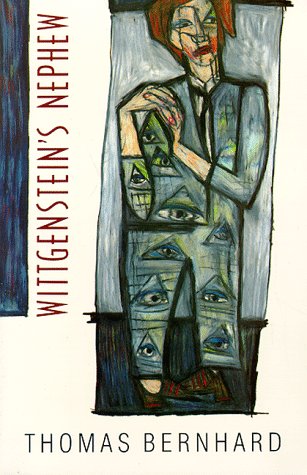
Thomas Bernhard: Wittgenstein's Nephew

Wittgenstein's Nephew is an autobiographical short novel by the Austrian writer Thomas Bernhard. I had first heard of him in one of the articles about the late German writer and one of my literary idols W G Sebald. Sebald considered him as an influence on his own writing although now after having read Wittgenstein's Nephew I can't imagine what could that influence be. They both share a deeply pessimistic worldview alright (like all Germanic writers I guess) but the sameness ends there (as far as I can extrapolate from reading this single book.) Sebald's melancholy resignation and a deep empathetic understanding of the human condition and the mysterious workings of the universe (Yes!) is replaced by a bitter and bilious fury in Bernhard. Their prose styles also couldn't be more different. Sebald's prose is classical and controlled while Bernhard believes in the sledgehammer approach, he drives home his point of view by repetition and rhetoric and the sheer fury of his anger and bitterness doesn't leave any room for any Sebaldian meditation or reflection. Bernhard also has little tolerance for cliches (not that Sebald is fond of them but he manages to avoid them completely) and one of the pleasures of reading Wittgenstein's Nephew is the way he makes fun of cliches by using them deliberately. Often many words and phrases are shown in italics or prefixed by qualifiers like "so-called" ("it was there that our friendship deepened".)

The novel is about the author-narrator's real life friendship with Paul Wittgenstein, the nephew of the famous philosopher of logic and language. Paul struggled with periodic bouts of madness and the author struggled with his lung disease throughout his life. In real life also Bernhard spent a couple of years in a sanatorium. Most of the book is about what Bernhard thinks of disease, both physical and mental. At one place in the book he divides the humanity into two mutually hostile and irreconcilable groups -- that of the healthy and the other of the sick. "The healthy never had the patience with the sick, nor, of course the sick ever had the patience with the healthy. This fact must not be forgotten."

He also gives some background about the life of Paul who, at least the author claims, was a distinguished thinker in his own right. Also, I didn't know that the Wittgenstein family was one of the richest in Vienna. And Paul like his illustrious uncle donated most of his fortune to others and himself led a life of penury and supported himself with the generosity of his relatives. Also the wiki article says, "His [Ludwig's] family also had a history of intense self-criticism, to the point of depression and suicidal tendencies. Three of his four brothers committed suicide." And actually it is this self-criticism that is I think the central subject of the book alongwith the madness that results from it.

What is most strange about the book is that often sympathetic accounts of his friend's illness are punctuated by author's own rants against, well, basically everything. This is the author railing against nature:

I know nothing about nature. I hate nature, because it is killing me. I live in the country only because the doctors have told me that I must live in the country if I want to survive--for no other reason. In fact I love everything except nature, which I find sinister; I have become familiar with the malignity and implacability of nature through the way it has dealt with my body and soul, and being unable to contemplate the beauties of nature without at the same time contemplating its malignity and implacability, I fear it and avoid it whenever I can.

He doesn't think of doctors, specially those in the psychiatry profession very highly too:
Like all other doctors, those who treated Paul continually entrenched themselves behind Latin terms, which in due course they built up into an insuperable and impenetrable fortification between themselves and the patient, as their predecessors had done for centuries, solely in order to conceal incompetence and cloak their charlatanry. From the very start of their treatment, which is known to employ the most inhuman, murderous, and deadly methods, Latin is set up as an invisible but uniquely impenetrable wall between themselves and their victims. Of all medical practitioners, psychiatrists are the most incompetent, having a closer affinity to the sex killers than to their science.

He then says that all his life he has "dreaded nothing so much as falling into their hands" and that they are "a law unto themselves." He reserves even more bitter and angry words for the Austrian government and the official literary establishment.
Accepting a prize is in itself an act of perversity, my friend told me at the time, but accepting a state prize is the greatest.
In real life also Bernhard is famous as a "nest-fouler" in his native country and had forbade the staging of all his plays in Austria in his will. He despises the Austrian theatre management, the Austrian actors, directors who mangle his plays. Surprisingly he praises the Swiss-German actor Bruno Ganz (Wings of Desire, Downfall) very highly. He says this after the theatre management refused to hire Ganz for the production of one of his plays:
Their opposition was prompted not only by existential dread, as it were, but by existential envy, for Bruno Ganz, a towering theatrical genius and the greatest actor Switzerland has ever produced, inspired the ensemble with what I would describe as the fear of artistic death. It still strikes me as a sad and sickening piece of perversity, and an episode in Viennese theater history too disgraceful to be lived down, that the actors of the Burgtheater should have attempted to prevent the appearance of Bruno Ganz, going so far as to draw up a written resolution and threaten the management, and that the attempt should have actually succeeded. For as long as the Viennese theater has existed, decisions have been made not by the theater director but by the actors. The theater director has no say, least of all at the Burgtheater, where all the decisions are made by the matinee idols, who can be unhesitatingly described as feebleminded -- on the one hand because they have no understanding of the theatrical art and on the other hand because they quite brazenly prostitute the theater, both to its own detriment and to that of the public -- though it has to be added that for decades, if not for centuries, the public has been prepared to put up with these Burgtheater prostitutes and allowed them to dish up the worst theater in the world.

He hates coffee-houses and the literary people who go there. Not surprisingly he likes reading Schopenhauer, perhaps the gloomiest philosopher who ever lived. In the end he movingly, though still maintaining his highly anti-sentimental tone, describes the last days of his friend and then cruelly narrates how he shunned his friend like everyone else during his last days because he was "afraid of a direct confrontation with death." He then says:

I had traced his dying over over a period of more than twelve years. And I had used Paul's dying for my own advantage, exploiting it for all I was worth. It seems to me that I was basically nothing but the twelve-year witness of his dying, who drew from his friend's dying much of the strength he needed for his own survival. It is not farfetched to say that this friend had to die in order to make my life more bearable and even, for long periods, possible.

Bernhard's bitter pessismism is curiously very entertaining and very addictive. Personally also I feel that if you can't drive away melancholy, at least be bitter and pissed off with everything. It is much better than Sebaldian passive resignation which is much more destructive and useless. Unfortunately these days I am in the Sebaldian mode, and even reading it didn't change my mental state. Anyway read it and decide for yourself.

And finally thanks to cheshire cat for recommending me the book! This looks like a nice site about his life and works.

Tuesday, December 27, 2005

Best Books of Fiction I Read This Year

I was trying to compile a top 10 list of films that I saw this year but then balked at the idea, after I realised what a huge enterprise that would be. I saw films beginning from January at a rate that would drive any normal person nuts. Most of them were old classics, mostly from Europe. I didn't see many "new" films released in the year although I have tried to make up for it in the last two months. What I didn't do this year was to read a lot of books. But whatever I read was all invariably brilliant. Here's a list of those books:

  1. Hunger by Knut Hamsun: By turns funny and harrowing, this portrait of a young struggling writer slowly losing grips on his mind and reality is unlike anything I have read in a long while. Its like an experimental, avant-garde version of Crime and Punishment, only that there is no crime and no punishment in it but in its feverish evocation of the inner life a tormented character it surpasses even Dostoevsky.
  2. Youth by J M Coetzee: Although far more clinical and objective in its approach, this is no less harrowing than Hunger in its depiction of the portrait of an artist as a young man. In this largely autobiographical tale, Coetzee tells the story of a young computer programmer working to make his ends meet in harsh winters of London. Our hero reads Rilke and Pound, watches the movies of Antonioni and Bergman and in the nights, longs painfully for a female muse who will spark off the artistic fire in him. Nothing like that ever happens of course and the novel ends without any catharsis or closure or any kind of hope in future. This may sound bleak and indeed it is but in its enthralling depiction of the life of the mind, Youth also is remarkably uplifting by showing that art indeed always triumphs over the misery of life.
  3. The Red and the Black by Stendhal: This story of a young and scheming yet romantic and naive social climber who would do anything to get ahead in a society filled with hypocrites, was the biggest literary entertainment of the year for me. There are a few dull pages towards the end, which would be of interest only to students of French history and society in the eighteenth century but overall it is a gripping tale full of romance and intrigue, all served with a most vicious irony and dark humour. I was reading the reviews of Woody Allen's latest film Match Point and the story looks remarkably similar to this book although I suspect the film ends differently.
  4. The Rings of Saturn by W G Sebald: I didn't know whether to put this book under fiction or non-fiction but since the effects it produced in me are generally associated with imaginative fiction--all very mysterious, very difficult to put in words--a mixture of sadness, loneliness and the feeling of being transported to a different time-space realm, I call it a work of fiction even though it is, at least on surface, a book of facts. I had written about the book earlier here. In fact it was my first post on this blog.
  5. Pale Fire by Vladimir Nabokov: I had just finished reading the book when I started this blog in May this year, that's where the 'Zembla' in the title comes from. This story of a mad literary critic, who thinks he is the exiled king of Zembla, the distant northern land, writing 200 page annotation on the 999 line eponymous poem by his friend John Shade, is often hilarious, frequently inscrutable (because of its obscure literary allusions, at least for literary newbies like me) but is always insightful about how literature works. And that poem...brilliant, dark and very funny!
There were few other books too. Immortality by Milan Kundera, Some plays by Ibsen including the classic A Doll's House, Sebald's Vertigo, a few short stories by Nabokov including the brilliant Admiralty Spire, Mario Vargas Llosa's Who Killed Palomino Molero?. Everything was uniformally brilliant. Great entertainment and great education from each single one of them.

That's pretty much all that I read this year in fiction. I wrote about the non-fiction books here.

Friday, September 23, 2005

W G Sebald's Vertigo


This is the most recent book I have finished reading. I will not bore you with what I think of the book (it is brilliant, by the way) but will just suggest you to get a copy of the book and start reading. There are many excellent reviews and articles on the internet about Sebald. This one in partcular was really good.

So who is W. G. Sebald, this peculiar writer who resurrects figures from the past only to follow them like an undertaker to their deaths; this connoisseur of eccentrics and madmen, of the detritus of history; this poet and swindler who, according to all accounts, doubles as a professor of languages somewhere in the east of England? Whoever he may be, all we can say for sure is that he is restless, and we can only wait until he briefly appears to us again, like one of those phantom creatures rarely sighted, mythical, and easily frightened away.


Nicole Krauss, who wrote the review, is herself a novelist. Her most recent novel The History of Love was recently published. And she is quite good-looking! Read this.

Thursday, June 16, 2005

"The Tyranny of Memories"


The following extract is from W G Sebald's The Rings of Saturn. This is actually taken from the notebooks of nineteenth century French writer and memoirist Chateaubriand, whom Sebald (or the narrator), quite clearly finds a kindred spirit.

But the fact is that writing is the only way in which I am able to cope with memories which overwhelm me so frequently and so unexpectedly. If they remained locked away, they would become heavier and heavier as time went on, so that in the end I would succumb under their mounting weight. Memories lie slumbering within us for months and years quietly proliferating, until they are woken by some trifle and in some strange way blind us to life. How often this has caused me to feel that my memories and the labours expended in writing them down are all part of the same humiliating and, at bottom, contemptible business! And yet, what would we be without memory? We would not be capable of order the simplest thoughts, the most sensitive heart would lose the ability to show affection, our existence would be a never ending chain of meaningless moments, and there would not be the faintest trace of past. How wretched this life of ours is!--so full of false conceits, so futile, that it is little more than the shadow of chimeras loosed by memory.


I am trying to write something on the connection between Sebald and Nabokov. My curiosity has been piqued after reading this passage (although Nabokov is much more benign when it comes to describing the tyrannies of memories) and Sebald's essay on Nabokov's Speak, Memory in his latest essay collection Campo Santo. But it needs some more thinking and some more time.

Previous posts on The Rings of Saturn here and here.

On Speak, Memory.

Some quotes from the book:
The Cradle Rocks above an Abyss
Death, A Shameful Family Secret?

Friday, May 06, 2005

The God of Melancholy

I was wondering about the curious title of The Rings of Saturn after finishing the book because although the book is about lots of different things, astronomy is nowhere writer's concern. After thinking about it for some time I came to some interesting conclusions.

The book starts with the following epigraph from an encyclopedia entry on the rings of Saturn:

The Rings of Saturn consist of ice crystals and probably meteorite particles describing circular orbits around the planet's equator. In all likelihood these are the fragments of former moon that was too close to the planet and was destroyed by its tidal effects(-->Roche Limit)

The planet Saturn is generally considered to be the patron god of melancholy. A god for sadness? You will ask. Well, as it turns out, the Greeks were not a very happy people. They understood the tragedy of human condition much better than today's channel surfing and crack-wise-with-friends generation. But that doesn't solve the puzzle of the meaning of the title. Does Sebald mean that the beautiful thing (the moon) that once was, is now destroyed as perhaps does every other thing, and is now replaced by another beautiful thing by some mysterious force in nature which takes care of transience and mutability of everything. The rings, perhaps, remind us of the inevitable cycle (and hence the rings) of destruction that history goes through. This is what he writes somewhere else in the book:

"On every new thing there lies already the shadow of annihilation. For the history of every individual of every social order, indeed of the whole world, does not describe an ever-widening, more and more wonderful arc, but rather follows a course which, once the meridian is reached, leads without fail down into the dark."

Sebald, not surprisingly, doesn't believe in the idea of historical progress, his view of history is more attuned to Nietzschean eternal recurrence. Whatever has happened will happen again and whatever is happening has already happened before in the past!

The title may also signify the strange connection between beauty and sadness. Doesn't anything beautiful also leave you with a faint feeling of sadness, by thinking that what you are looking at will not last, will perish sooner or later. And if you want to cling or attach to that beautiful thing, it will ultimately result in pain and a feeling of loss. Or the connection may also mean that when you are sad the world looks more beautiful. This may sound strange. And yes to some extent it is definitely false. After all who can forget Hamlet's (the most famous depressive in literature) lament when he compares earth to a sterile promontory and the overhanging firmament to a foul and pestilent congregation of vapours and cries out in pain as to how weary, stale, flat and unprofitable the uses of the world are to him. But be that as it may, an enlightened sadness (of the kind the narrator of the book feels) does sharpen your perception and cleans up your mind. So that you start seeing new things which were hidden earlier when you were happy and hidden connections between things and everything starts making sense in a mystical, elevated sort of way. I already sound like a new age lifestyle philosopher and Guru who wants to sell the idea of salvation through sadness and I hate that. So I will stop now.

Thursday, May 05, 2005

The Rings of Saturn

Thought I would start with this amazing book that I recently finished reading. The Rings of Saturn by W G Sebald is one of the strangest and most sublime of books I have read in a long time. On surface it just appears to be a normal travel book with lots of biographical and historical anecdotes thrown in but what makes it apart from the run of the mill travel books is that the writer is not interested in the landscapes just for the sake of it, he is interested in the desolate, lonely landscapes only in so far as they provoke some thoughts and feelings in the writer's head and with Sebald those thoughts and feelings are invariably deeply and movingly melancholic and yet the book is surprisingly extremely uplifting overall (which I use as an approving term). I came out of the book with a sense of amazement and wonder at having seen some mysterious connection between everything which was completely invisible to the eyes earlier. In this book Sebald achieves that rare, difficult aim of every artist--using one's raw experiences and making something beautiful and meaningful out of it by putting those experiences in a unified structure using the power of one's imagination and creativity.

The search for meaning and unity becomes even more important given the subject matter of the book. The writer is taking a walking tour of the seashore English counties of Suffolk and Norfolk and muses variously on different subjects ranging from the horrors of Belgian colonialism, an anatomical painting by Rembrandt, palace intrigues in the nineteenth century China, the exiled life of various literary figures like Joseph Conrad and many other people and things. All these and more seem too disparate and random to make any sense as a whole but in Sebald's hands these things become mysteriously connected to become one unified whole. The theme perhaps that binds all these things is the idea of the transience of all things human and even non-human or what Thomas Browne, one of the nineteenth century personages described in the book, calls the "opium of time" and "iniquities of oblivion".

In writing the book Sebald does what every writer dreams of doing: he manages to move through space and time seamlessly and relates his story in what might be called in philosophical terms, in Eternal Present. And by giving such contemporaneous weight to the people and events, which are marginalised by the cruel indifference of the relentless march of time, he also undoes to a large extent the iniquities of oblivion.

I was wondering about the mysterious effects the book had on me and reached a conclusion that perhaps the book affected me so much because these days I am also feeling somewhat "exiled" (I am currently in Chicago far away from my "home" and feeling desperately alone) as the narrator and the various people that he describes in the book do. Or perhaps it has something to do with my Proustian obsession with the "remembrance of things past" or the "search of lost time".

There are many more thoughts and feeling (all sublime and nothing ridiculous!) that I can go on writing about but more for later posts.