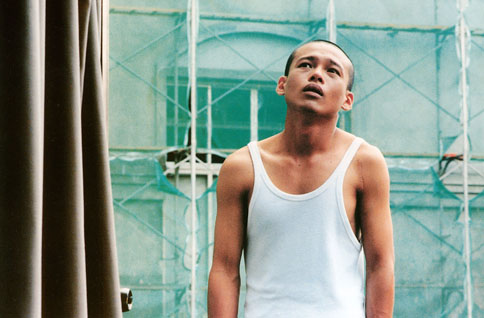
The Wayward Cloud

The Taiwanese film director Tsai Ming-Liang has one of the most recognizable style in the whole of contemporary cinema. Not just the style but also in his subjects, themes, characters and settings he doesn't veer much. His powerful and disquieting studies of urban anomie and melancholia hark back to Antonioni's films in the sixties, only that after seeing his films, you realize that perhaps the sickness of the soul that Antonioni diagnosed so eloquently has grown even worse with time. In fact watching The Wayward Cloud, specially its ending, makes one feel like reaching a cul-de-sac, an impasse, a (literal) dead-end.
The Wayward Cloud is some kind of a sequel to Tsai's earlier What Time is it There? (perhaps his best work) but one need not have seen it to appreciate it. In fact Tsai's whole oeuvre is so obsessively consistent that it seems like he is making the same film over and over again and if you see one film after the another you will notice many intertextual references and other striking symbolisms which you would definitely have missed the first time around. Even the watermelons in this film don't just appear out of nowhere. They were right there in his first film too! And so is his fascination with water. In fact if you haven't seen his other films his use of these symbols will appear heavy-handed and a little too explicit.
Coming back to the film, In What Time is it There? a young Taiwanese watchseller sells his personal dual time watch to a girl who is leaving for Paris and then gets obsessed with her, specially with the Paris time zone and starts setting every watch he can come across to the same time zone. Meanwhile the girl wanders around in the parks, subways and cafe of Paris feeling lonely and isolated. Now in this film the girl has returned back from Paris and taken an apartment just next to the boy who has now taken a new job of acting in pornographic films. In fact the films are being shot with a minimal crew right in his apartment. They soon meet and develop a hesitant, tentative and mostly silent relationship without the girl knowing about his profession. In the meanwhile Taiwan is under a severe heat wave and water has become costlier than water melons, which is all a ruse (and of course another symbol, "no water=no love=no life") for Tsai to invent imaginative uses of the fruit all with sexual connotations. (Notice the obvious metonymic use as a male organ above and a female organ below.) It all doesn't end happily though. She soon learns the truth in a shocking sequence which is also the last scene of the film. (I won't reveal what happens, though I myself knew about it.)
The most obvious way to see this film is to see it as an attack on pornography. But that will be too easy. Porn might be an easy target but Tsai is perceptive enough to realize that it is only a symptom not a cause. It is the disease of inarticulation and emptiness that finds itself reflected in the business of pornography. Though I was hoping a more explicit attack on the culture of commodification that is ubiquitous in advanced capitalist societies. Porn, if you see closely, is not really about sex and sexual fulfillment but rather about economics and market. You create a market, create a demand and then supply and the cycle continues. Porn is just an extreme example. The whole culture industry of entertainment thrives on commodification of human desires and human personality. There are hints about these too in the film. The main events are also punctuated by increasingly absurd, abrupt and imaginary musical interludes (though to an experienced consumer of Bollywood films like me, it felt just nostalgic.) These song and dance sequences are perhaps meant to deflate the traditional representations of romantic love. There are songs of longing and loneliness, and then songs about lovers squabbling with each other, all meant to show how artificial and empty these sentiments are as represented. So ultimately as means of sexual communication one will have either these songs or the hard core porn, both artificial and false, there is no third way. It is obviously an extreme position, which is surely not supposed to be defended but rather to be thought and argued about. Not surprisingly Tsai doesn't offer any solution at all. In fact the ending is so extreme that he perhaps feels there is no solution at all!
I have now seen all of Tsai's films except for his latest I Don't Want to Sleep Alone. I have liked all of them a lot except for The River (which has another shocker of an ending) and this. Somehow in these films I felt he was being too negative, not that I have a problem with negation (I think it is an important thing to do, something art should do more of) but rather his style is more suited for understatement and indirection. The confrontational approach of the last scene in effect overwhelms the entire film. In the end you just remember the last act. Which is a shame because the earlier parts are no less eloquent in their own way. In case you are planning to watch it, it contains a lot of explicit pornographic scenes. All in all, not a very healthy and nice way to spend late Saturday evening, specially if you are already feeling lonely!
This is another review. It has mostly been panned by critics. Very poor rating on Rotten Tomatoes too. I myself will remain non-committal.